Living on the Gulf Coast means you already know the drill. Hurricane season runs June through November, and every year there’s at least one storm that makes you wish you had a better plan. But emergency food storage isn’t just for worst-case scenarios anymore. Supply chain hiccups, power outages, and even a bad week of weather can leave store shelves empty fast. Think of a solid food supply the same way you think of homeowner’s insurance: you hope you never need it, but you’re really glad it’s there when you do.
This guide cuts through the marketing fluff and gives you honest, practical picks for the best emergency food storage options in 2026. No doom-scrolling required. Whether you’re building your first kit or upgrading what you already have, these three options cover most households on a real-world budget.
How Much Food Do You Actually Need?
Here’s where most people get tripped up, and honestly, it’s partly the industry’s fault. Emergency food manufacturers love to advertise “120 servings” or “30-day supply” on the label, but those numbers can be seriously misleading when you look at the actual calorie counts.
A typical adult needs roughly 2,000 calories per day to maintain basic function. Kids, elderly folks, and people doing light activity can get by on a bit less. Anyone doing heavy physical work (think clearing debris after a storm) will need more, closer to 2,500-3,000 calories.
Now here’s the math that matters. A lot of freeze-dried “servings” clock in at just 100 to 300 calories each. So that bucket claiming “30 servings” might only deliver 4,500 to 9,000 total calories. Divide that by 2,000 calories per day and you’re looking at roughly 2 to 4.5 days of real food, not 30.
Let’s run through a quick example. Say a kit advertises 60 entree servings at an average of 250 calories each. That’s 15,000 total calories. At 2,000 calories per day for one adult, that’s about 7.5 actual days of food. For two adults, cut that to roughly 3.75 days. Not quite the “two-week supply” the box might suggest.
The practical takeaway: always look at total calories on the nutrition label, not just serving counts. Then divide by 2,000 to get a realistic day count. Use that number to figure out how many kits or buckets you actually need to hit your target (most preppers aim for 2 weeks minimum, with 30 days being the sweet spot for Gulf Coast hurricane prep).
A few other things to keep in mind. Most freeze-dried meals require hot water, so factor in a way to heat water during a power outage (a camp stove with extra fuel is a must). And don’t forget water itself: freeze-dried foods need roughly 1 to 2 cups of water per serving to rehydrate properly.
Quick Comparison
| Kit | Servings | Shelf Life | Calories Reality | Price | Best For |
|---|---|---|---|---|---|
| Mountain House Bucket | 24 entree servings | 30 years | ~5,000-6,000 total cal (approx. 2-3 real days solo) | ~$80 | Best taste, long-term storage, starter kits |
| ReadyWise 60-Serving Entree Bucket | 60 entree servings | 25 years | ~13,000-15,000 total cal (approx. 6-7 real days solo) | ~$90 | Best value per dollar, family stacking |
| Augason Farms 30-Day 1-Person | ~307 servings | 25 years | Modest per-day calories; read label carefully | ~$120 | Longest real duration, broadest variety |
Best Tasting Freeze-Dried: Mountain House Bucket
If taste is a priority (and when you’re stressed and tired after a storm, it really matters), Mountain House is the gold standard. Their freeze-dried meals have been around since the 1960s, originally developed for backpackers and outdoor enthusiasts, and the quality shows.
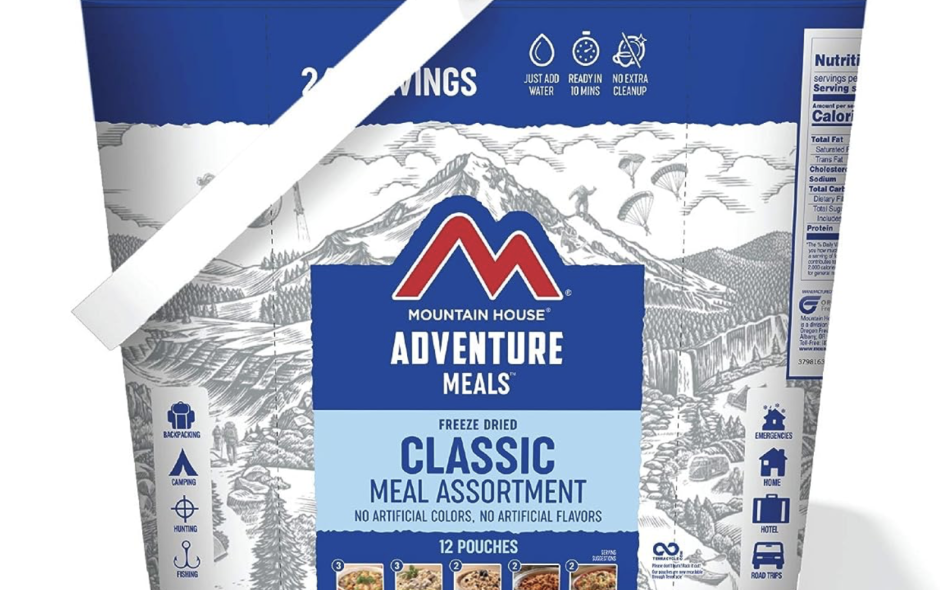
The Mountain House bucket includes 24 entree servings across popular meals like lasagna with meat sauce, chicken fried rice, beef stroganoff, and chili mac. Each serving is genuinely satisfying, and more importantly, the food actually tastes like food. That’s not something you can say about every emergency kit on the market.
The 30-year shelf life is the longest in the industry, which means you buy it once and it sits in your closet (or under your bed, or in your garage) ready to go. The sealed mylar pouches inside the bucket hold up to humidity extremely well, which is a real concern here on the Gulf Coast where even sealed spaces can get damp.
Now, the honest calorie math: 24 servings at roughly 200-300 calories each puts you at around 5,000 to 6,000 total calories. That’s about 2.5 to 3 days of food for one adult. So Mountain House buckets are excellent as part of a rotation, but you’ll want several of them (or supplemental food) for a true two-week supply. Think of each bucket as a building block, not a complete solution on its own.
At around $80, the Mountain House bucket is priced fairly for what you get. You’re paying for top-tier taste and the longest shelf life available. Read our full Mountain House review here, or grab yours directly below.
Check Price on Amazon – Mountain House Emergency Food Bucket
Best Value Entree Bucket: ReadyWise 60-Serving
The ReadyWise 60-Serving Entree Bucket is the workhorse pick for budget-conscious preppers who want to build serious food storage without emptying their wallet. Sixty entree servings at around $90 works out to about $1.50 per serving, which is genuinely hard to beat in the emergency food space.
ReadyWise offers a solid variety of entrees: pasta dishes, soups, rice-based meals, and more. The quality is good, not Mountain House level, but perfectly acceptable for emergency use and rotation. If you’re feeding a family, the stackable bucket design is a big practical win. They stack cleanly in a closet, pantry, or storage room without wasted space, which matters when you’re trying to store several months of food in a Florida home that’s already short on storage.
The 25-year shelf life is on par with most of the industry and is more than enough for long-term storage. Realistically, you’ll rotate through these long before they ever expire.
Back to the calorie math. Sixty servings averaging around 220-250 calories each gives you roughly 13,000 to 15,000 total calories. For one adult at 2,000 calories per day, that’s about 6.5 to 7.5 real days of food. Two adults cuts that to roughly 3 to 4 days. Still, at $90, buying two of these buckets for around $180 gives one adult a legitimate two-week supply, and that’s a solid deal.
One thing to keep in mind: like all freeze-dried entrees, these require hot water to prepare properly. Have your camp stove situation sorted before hurricane season hits.
Read our full ReadyWise review here, or pick up a bucket on Amazon below.
Check Price on Amazon – ReadyWise 60-Serving Entree Bucket
Best 30-Day Single-Person Supply: Augason Farms 30-Day
The Augason Farms 30-Day 1-Person Emergency Food Supply is the most comprehensive single purchase on this list. With roughly 307 servings packed into one kit, it covers a huge range of food types: breakfast items, entrees, side dishes, drinks, and snacks. It’s the closest thing to a true all-in-one solution you’ll find.
Augason Farms has been in the food storage business for decades and has a solid reputation for quality and value. The 25-year shelf life is reliable, and the variety here is a genuine advantage over single-category entree buckets. When you’re stuck at home for an extended period, food variety matters more than you’d expect for morale and mental health.
Here’s where you need to read carefully, though. At around $120 for the full kit, the price is reasonable, but the per-day calorie count from this kit can be modest depending on which servings you’re eating. Some of the included items (drinks, side dishes, breakfast items like oatmeal) are lower calorie than full entrees. If you’re relying on this as your only food source, supplement it with calorie-dense shelf-stable items from your regular pantry: canned beans, peanut butter, crackers, cooking oil, and rice go a long way toward filling the calorie gap.
For single-person Gulf Coast hurricane prep, this kit is a great foundation. It’s the best option for someone who wants to buy one thing, store it, and know they have a genuine multi-week foundation in place. Just supplement it, don’t treat it as fully calorie-complete on its own.
Read our full Augason Farms review here, or grab it on Amazon below.
Check Price on Amazon – Augason Farms 30-Day 1-Person Food Supply
Building a Realistic Pantry
Freeze-dried buckets and kits are excellent tools, but they work best as part of a broader food storage strategy. Here’s how to think about building a pantry that actually carries you through a serious disruption.
Layer 1: Everyday pantry rotation. Keep more of what you already eat. Canned goods, dry beans, rice, pasta, oats, peanut butter, canned fish and meat. These are cheap, calorie-dense, require no special prep gear, and rotate naturally through your daily cooking. Aim for two to four weeks of this stuff as your base layer.
Layer 2: Emergency kit food. This is where your Mountain House, ReadyWise, or Augason Farms buckets come in. These are for when cooking from scratch isn’t practical, when power is out for days, or when you need to move fast. They store for decades, require minimal prep, and take up relatively little space.
Layer 3: Water and cooking capability. Food storage is useless without water and a way to prepare meals. On the Gulf Coast, assume you could lose running water for several days after a major storm. Store at least one gallon of water per person per day, with two weeks as the minimum target. Add a quality camp stove, extra fuel canisters, and a reliable water filter or purification tablets.
Practical tips for Gulf Coast storage. Heat and humidity are your enemies. Keep food storage in the coolest, driest part of your home. A climate-controlled interior closet or under-bed space beats a garage or attic for long-term storage. Rotate emergency kits every few years even if the shelf life is longer, and always check seals before storing. Label everything with purchase dates.
Don’t try to build your entire supply at once. Buy one bucket a month for a few months and you’ll have a meaningful supply before hurricane season peaks without feeling the financial hit all at once.
FAQ
Are freeze-dried foods really worth the cost compared to just stocking up on canned goods?
Both have a place. Canned goods are cheaper, require no special prep tools, and work even without power (cold canned beans aren’t gourmet, but they work). Freeze-dried foods offer longer shelf life, lighter weight, better variety, and better taste when prepared correctly. For most households, the answer is both: a solid canned goods rotation for the base layer and freeze-dried kits for extended emergencies or situations where you need to move quickly.
How do I store emergency food properly in a hot, humid climate?
Keep food in the coolest, driest space in your home. Interior closets are far better than garages or attics in Florida’s climate. Ideal storage temperature is below 70 degrees Fahrenheit, though most products are tested to handle higher temps for reasonable durations. Avoid direct sunlight and keep buckets off concrete floors (which can wick moisture). If you have any air-conditioned interior space, that’s where your food storage belongs.
How long should my emergency food supply last?
FEMA recommends a minimum of 72 hours. Most experienced Gulf Coast preppers aim for two weeks minimum, since major hurricanes can disrupt supply chains and infrastructure for 7 to 14 days or longer. Thirty days is the goal for households that want real peace of mind heading into hurricane season. You don’t have to get there overnight: build toward 30 days gradually.
Can I feed my whole family from one emergency food bucket?
In most cases, no. Most buckets are sized for one person for a limited number of days once you do the honest calorie math. For a family of four, plan on multiplying your single-person food needs by four. The ReadyWise and Augason Farms options are good for stacking multiples at reasonable cost. Make sure to account for kids’ calorie needs and any dietary restrictions or allergies.
What’s the biggest mistake new preppers make with food storage?
Buying food they would never normally eat. If your family doesn’t eat it when times are good, a stressful emergency situation isn’t going to make it more appealing. Stock familiar foods your household actually likes whenever possible. The second biggest mistake is confusing “servings” with “days of food” without doing the calorie math first.
Bottom Line
Building a solid emergency food supply doesn’t have to be complicated or expensive, and it’s absolutely not about paranoia. On the Gulf Coast, it’s just practical preparation for a region that deals with real hurricane risk every single year on top of the occasional supply chain curveball.
If you want the best tasting option and the longest shelf life, grab the Mountain House Bucket and stock several of them. If you want the best value and stackability, the ReadyWise 60-Serving Entree Bucket is your play. If you want the most complete single-purchase foundation for one person, the Augason Farms 30-Day Supply covers the most ground for $120.
Do the calorie math before you buy. Supplement with a regular pantry rotation. Store water. Have a way to cook without electricity. That combination covers the vast majority of what Gulf Coast households actually face in a real emergency, and it’s all achievable without a bunker or a major lifestyle change.
Some links on this page are Amazon affiliate links. I only recommend gear I personally own – if you buy through my link, I may earn a small commission at no extra cost to you.


