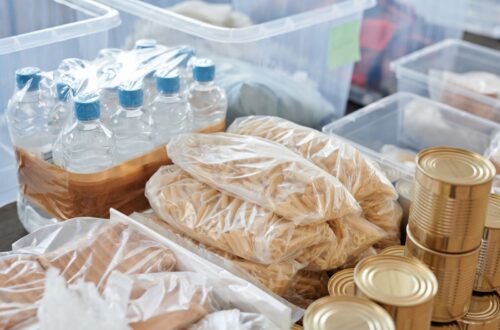
An evacuation order changes the food question. At home you have a pantry, a bucket in the closet and a stove in the garage. In the car you have what fits behind the seat, and the first day on the road is usually spent in traffic between gas stations that have sold out of everything. The food that goes in the evacuation kit has to be light, sealed, kept within its maker’s temperature limits until the trip, and ready with nothing more than hot water. Most of what is in a kitchen fails at least one of those tests.
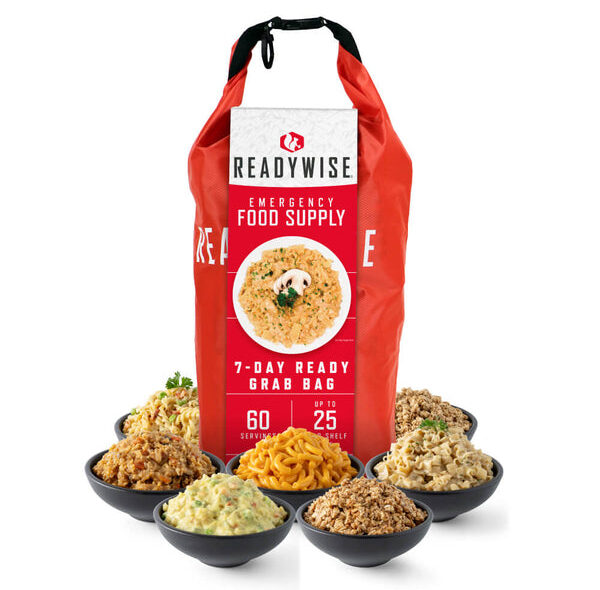
The ReadyWise 7-Day Grab Bag is the brand’s answer: ten 6-serving pouches of freeze-dried and dehydrated meals in a 10-liter dry bag, rated by ReadyWise at 13,920 calories, 7 days at 1,988 calories a day, with a shelf life of up to 25 years. This review treats it as what it is, the car-kit food for the plan in our hurricane evacuation car kit guide, and looks hard at the water it needs, because that is the figure that decides whether it belongs in a vehicle.
Who It Is For
This bag is for the household that evacuates. If the decision tree in our evacuate or shelter in place guide lands on “leave,” the grab bag is the food that goes in the trunk the night before: one person’s meals for a week, a couple’s for three and a half days, or under two days for a family of four, in a bag you can carry in one hand. It also suits a second home or an office kit, anywhere a bucket is too big and a box of bars is too grim.
It is not a shelter-in-place supply. A 60-serving bag is a week for one adult by the brand’s own math, and the water it needs makes it a poor fit for a car that is also carrying the drinking water. For the house, the ReadyWise 132-Serving bucket or the buckets in our two-week food supply guide are the right scale.
Key Specs
| Specification | ReadyWise 7-Day Grab Bag |
|---|---|
| Servings | 60 (10 pouches of 6 servings) |
| Meals included | Creamy Pasta and Vegetables (2 pouches), Savory Stroganoff (1), Cheesy Macaroni (1), Teriyaki Rice (2), Brown Sugar and Maple Multi-Grain Cereal (2), Crunchy Granola (1), Potatoes and Chicken Pot Pie (1) |
| Total calories | 13,920 (ReadyWise) |
| Calories per serving (average) | 232 (13,920 divided by 60) |
| Calories per day as rated | 1,988 for 7 days (ReadyWise) |
| Days at 2,000 calories a day | 6.96, one adult (13,920 divided by 2,000) |
| Protein | 342 g total (ReadyWise) |
| Water to prepare | About 60 cups, roughly 1 cup per serving on average (ReadyWise); 3.75 gallons for the whole bag |
| Packaging | Sealed Mylar pouches in a 10-liter dry bag |
| Shelf life | Up to 25 years, “depending on storage conditions and product type” (ReadyWise FAQ) |
| Storage condition the claim assumes | Cool, dry place, 50 to 70 F, away from sunlight and humidity |
| Weight and dimensions | Not published |
Read the serving line and the calorie line together. Sixty servings sounds like sixty meals; at 232 calories each, it is closer to twenty adult meals, which is exactly the one-person week ReadyWise states. The bag is honest about that on its own page, with the 1,988-calories-a-day figure printed next to the serving count.
What We Like
The calorie math is published and it adds up. ReadyWise gives a total (13,920), a daily figure (1,988) and a serving count (60), and the three agree with each other, which is more than many emergency food listings manage. That makes the bag easy to plan around: one bag is a week for one adult, or three and a half days for two, or two days and change for a family of three. Our food supply guide uses the same calorie-first method for the house.
The dry bag is the right container for a vehicle. A 10-liter roll-top keeps the pouches together, keeps spilled water or a leaking cooler off them, and is the size of a small daypack rather than a pail. The pouches themselves are the brand’s standard Mylar with oxygen absorbers, so a punctured pouch costs one pouch, not the bag.
The menu is dinners and breakfasts, not just entrees. Two cereal pouches and a granola pouch cover mornings, and the seven entree pouches cover the hot meals. For a child or a stressed adult who will not eat a ration bar, a bowl of hot pasta on the second night of an evacuation does more for morale than its calories suggest.
Limitations
Water is the catch. At the brand’s average of a cup per serving, preparing the whole bag takes about 60 cups, 3.75 gallons, and it should be boiling. In a car that is also carrying a gallon per person per day of drinking water, that is a second, separate water line and a stove or a way to heat water at a rest stop. The ration bars in our roundup need no water and no heat, which is why the car kit should carry both: bars for the road, the grab bag for the first nights at the destination.
It is one person’s week. A family of four will empty it in under two days at full rations. Plan the count by calories, not by the “7 day” on the label.
The 25-year rating assumes a closet, not a trunk. ReadyWise’s own condition is 50 to 70 F out of sunlight and humidity, and a Gulf Coast vehicle in summer is none of those. If the bag lives in the car during hurricane season, bring it indoors for the rest of the year and treat it as a rotation item on a short cycle rather than a 25-year item; our freeze-dried shelf life guide explains what heat does to the label’s promise. ReadyWise does not publish a weight or dimensions, and anyone with food allergies should read the ingredient panel on each pouch, since the page does not carry a consolidated allergen statement.
Alternatives
The Grizzly Gear 3,600-calorie ration bar is the no-water, no-heat option for the same 72-hour evacuation window: one vacuum-sealed brick per person for three days, rated at 5 years, and built to sit in a hot vehicle. The ReadyWise 132-Serving bucket is the same food in shelter-in-place quantity, for the house rather than the car. For the whole evacuation load, from the jump starter to the document bag, start with the car kit guide.
Common Questions
Can you prepare the pouches with cold water?
ReadyWise’s directions call for hot water, and the pouches are multi-serving, so the practical method is to boil about six cups, a 6-serving pouch at roughly a cup a serving, on a camp stove or a car-adapter kettle, pour it into a pot or the pouch, and wait. Cold water rehydrates freeze-dried food slowly and unevenly. If there is no way to heat water on the road, eat bars the first day and save the grab bag for the destination.
How long does it last in a hot car?
ReadyWise does not publish a figure for heat exposure, only its storage condition of 50 to 70 F. The 25-year rating does not survive a summer trunk; the food does not become unsafe on a date, but quality falls off faster than the label implies. Keep the bag in the house and move it to the car when a watch is issued, or accept a short rotation cycle if it lives in the vehicle.
Is 60 servings really a week of food?
For one adult at the brand’s 1,988 calories a day, yes, by ReadyWise’s own arithmetic (13,920 calories over 7 days). For a couple it is three and a half days, and for four people under two. Count the people, divide the calories, and buy the number of bags that matches.
Bottom Line
The ReadyWise 7-Day Grab Bag is the hot-meal half of a hurricane evacuation kit: a one-person week of real breakfasts and dinners in a bag you can carry, with published calorie figures that actually reconcile. Pair it with ration bars for the hours on the road, store the water and the stove it needs, and keep it in the house until the watch goes up.
If it’s out of stock: the 4Patriots 1-Week Survival Food Kit covers the same seven days: 42 servings in light triple-layer Mylar pouches, about 9,240 calories in all by its label.
Updated 2026-11-11: the ReadyWise 7-Day Grab Bag was out of stock on Amazon, so we added an in-stock alternative.
Some links on this page are Amazon affiliate links. If you buy through them, Ultimate Prepper’s Guide may earn a small commission at no extra cost to you.