Water is the first thing a hurricane takes that you cannot do without. Municipal systems lose pressure when the power fails, boil notices follow almost every major landfall on the Gulf Coast, and the stores are empty of bottled water two days before the storm arrives. The households that come through comfortably are the ones that stored their own water before the watch was issued, in containers built for the job, and knew how much they needed.
This roundup compares three different kinds of container: a bathtub bladder that holds a family’s full two-week supply, a rigid military-style can for the garage and the truck, and sealed single-serve pouches for the kit that goes with you. The picks were chosen because they are in stock, current generation, and described by their manufacturers with figures we could check. It covers how much to store, what each container is good for, and which one belongs in which part of your plan. The sizing math lives in our guide to how much water to store for a hurricane; the long-term rotation and treatment routine is in How to Store Water Long Term.
How to Choose
Start with the CDC’s number. The CDC says to store at least 1 gallon of water per person, per day, for 3 days, and to try to store a 2-week supply if possible. That gallon covers drinking, cooking and brushing teeth, not just thirst, and the CDC says to store more for pregnant women, people who are sick, pets, and hot climates. A Gulf Coast August qualifies as a hot climate. For a family of four, the 3-day floor is 12 gallons and the 2-week target is 56 gallons, which is why a single bathtub bladder changes the math so completely.
Food-grade material, and nothing that ever held chemicals. The CDC says to use FDA-approved food-grade water storage containers where possible, and never a container that previously held liquid or solid toxic chemicals such as bleach or pesticides. Every pick below is described by its maker as food grade.
Match the form to the job. A bladder stores the most water in the least space but only once it is filled, which means the day before landfall. A rigid can is ready any time, carries in one hand, and survives a truck bed. A pouch is the only form that rides in a backpack or a glove box for years without a thought. Most households want one of each, not three of one.
Plan the rotation before you fill. The CDC says to replace self-filled stored water every 6 months and to observe the expiration date on store-bought water. A bladder is emptied after the storm; a can needs a calendar reminder; a pouch carries a printed date. Pick the container whose rotation you will actually do.
Know where it will live. The CDC says to keep stored water at a cool temperature (50°F to 70°F), away from direct sunlight, and away from toxic substances such as gasoline or pesticides. That rules out the sunny side of a garage next to the mower fuel, which is where most cans end up. Decide the spot first, then buy the container that fits it.
Storage is not treatment. None of these containers makes questionable water safe. If the tap is under a boil notice when you fill, treat the water first by the EPA’s emergency disinfection method (our long-term storage guide has the exact figures), and keep a filter or tablets for the week after the storm; our post-storm water safety guide covers that week.
Comparison Table
| Container | Capacity | Form | Food-grade material | Stackable or portable | Shelf life or rotation | Where it lives |
|---|---|---|---|---|---|---|
| AquaPodKit bathtub bladder | Up to 100 gallons (the listing title says 65 to 100, depending on the tub) | Bathtub bladder | Food-grade plastic that meets USFDA food storage guidelines, BPA free (listing) | Neither when full | Filled the day before landfall; the listing says the water stays fresh 8 to 16 weeks; replace self-filled water every 6 months if kept (CDC) | The bathtub during the storm; a drawer the rest of the year |
| Scepter 5 Gallon Military Water Container (green, sold as a 3-pack) | 5 gallons / 20 litres | Rigid can | Food grade material, BPA free (maker) | Portable by handle; stacking not published | Self-filled tap water: replace every 6 months (CDC) | Garage or closet floor, truck bed, evacuation vehicle |
| Datrex Emergency Water Pouch | 125 ml (4.227 fl oz) per pouch; 64 pouches per case (8 litres) | Sealed pouch | Polymer-foil pouch; produced in FDA-approved US facilities (maker) | Portable; packs flat in a bag or a case | 5 years from date of manufacture (maker) | Bug-out bag, car kit, office drawer, boat |
Two things the table cannot show. The bladder’s 60 gallons is the only figure here that reaches a family’s two-week supply on its own. And the pouch is the only container whose water is already treated, sealed and dated, which is why it belongs in every kit that may leave the house.
AquaPodKit Bathtub Bladder: The Top Pick
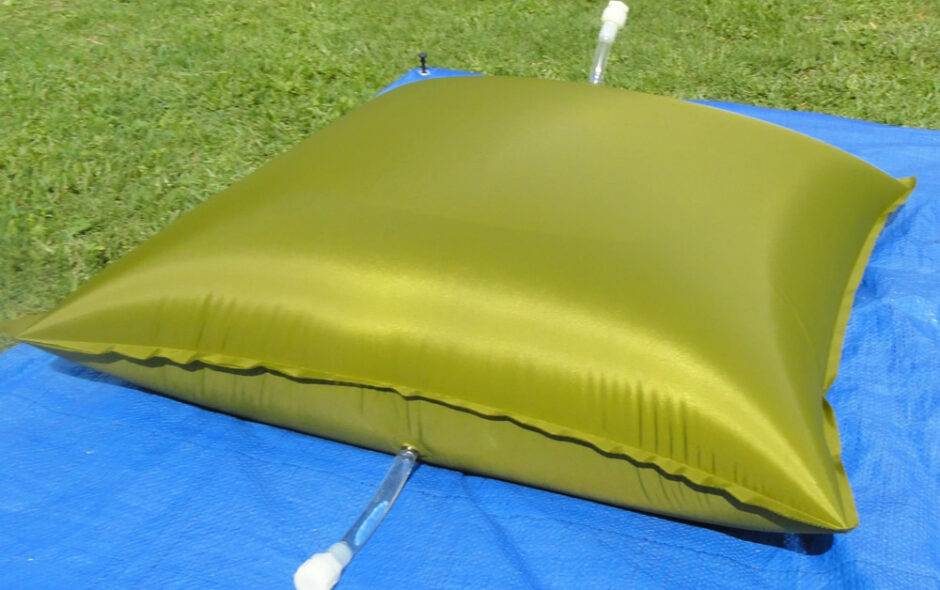
The AquaTank2 we picked first is out of stock on Amazon, so the top pick is now the AquaPodKit. It is a liner that sits in a standard bathtub and holds up to 100 gallons of drinking water drawn before the storm cuts the pressure; the listing title gives 65 to 100 gallons, so the real figure depends on your tub. The listing describes the liner as heavy-duty, food-grade plastic that meets USFDA food storage guidelines, BPA free and made in the USA. You lay it in the tub, connect the fill port to the faucet and fill it in 15 to 20 minutes, and an included siphon pump moves water into smaller containers. Nothing else in this roundup stores two weeks of water for a family in a kit that disappears into a linen closet the other 50 weeks of the year.
The trade-offs are real. A bladder stores nothing until you fill it, so it is useless for a no-notice outage and only as good as your habit of filling it when the watch is issued. Once full it is immovable, and unlike the AquaTank2 it has to sit in the tub, so the tub is out of service for bathing. The listing says the sealed liner keeps water fresh for 8 to 16 weeks; if you keep water stored longer, the CDC’s rule for self-filled water is to replace it every 6 months. For the week-long outage after a direct hit, though, it is the single most useful water purchase a Gulf Coast household can make. Our AquaTank2 review covers the day-before filling routine, which works the same way. Listing: AquaPodKit bathtub water storage on Amazon.
Scepter 5 Gallon Military Water Container: The Rigid Can
The Scepter military-style water container is the can you see strapped to the back of an expedition truck, and the reason is that it survives. Scepter lists the 5 gallon / 20 litre container as food grade material, BPA free, with superior impact resistance, in sand, black and American green. The green can (product 05177) is the one linked here, sold as a three-pack because the single can is out of stock. A full can weighs about 42 pounds by the weight of the water alone, which is the practical ceiling for a one-hand carry and the reason 5 gallons is the standard portable size.
What Scepter does not publish on the product page matters too: there is no stated empty weight, no dimensions and no stacking figure, so plan floor space by measuring a can rather than trusting a spec. The real role of a rigid can is the reserve that is ready without warning: filled from a chlorinated tap, dated with a marker, swapped every six months per the CDC, and stacked beside the generator fuel only if that fuel is somewhere else, because the CDC says to keep water away from gasoline. Two cans hold 10 gallons, short of the 12-gallon 3-day floor for a family of four, so plan on three; it is also the container that goes in the vehicle if you leave, which our evacuation car kit guide plans around. Listing: Scepter 5 gallon green water containers (3-pack) on Amazon.
Datrex Emergency Water Pouch: The Kit Water
Datrex water is what goes in life rafts. The maker lists a 125 ml (4.227 fl oz) pouch, 64 pouches to a case for 8 litres, a 5-year shelf life from the date of manufacture, and compliance with US Coast Guard requirements under ISO 18813:2006; the pouches are approved for use in USCG, SOLAS and ISO-9650 life rafts and produced in FDA-approved US facilities. The polymer-foil pouch is the point: it is sealed, flat and dated, though Datrex publishes no storage temperature range for a hot glove box.
It is not a storage solution for the house. Sixty-four pouches add up to a little over two gallons, which is two days for one person, and a single pouch is a few swallows. Its job is the bug-out bag, the office kit, the boat and the car, where a sealed ration you can forget about for five years beats a bottle you have to rotate. Pair a case with the 72-hour bug-out bag checklist and a small filter such as the Sawyer Squeeze or the LifeStraw, so the pouches are the margin and the filter is the supply. Listing: Datrex emergency water pouches on Amazon.
Which One for Which Reader
- A family riding out the storm at home: the AquaPodKit, filled the day before landfall, plus two Scepter cans already full for the hours before you think to fill the tub.
- A household that may evacuate: two Scepter cans in the vehicle and a case of Datrex pouches split between the bags, because a bladder cannot leave the house.
- A single person in an apartment: one Scepter can and a case of pouches; the 3-day floor is 3 gallons and a bladder needs a tub you may not want to give up.
- Anyone with a countertop gravity filter: the Big Berkey turns a tub bladder into two weeks of filtered water; store the water in the bladder and run it through the Berkey as you need it.
- The kit that lives in the truck year-round: Datrex pouches only. Datrex rates them at 5 years from the date of manufacture but publishes no storage temperature range, so keep the case out of direct sun.
Common Questions
How much water should I store for a hurricane?
The CDC’s figure is at least 1 gallon per person per day for 3 days, with a 2-week supply if possible, and more for pregnant women, sick people, pets and hot climates. Our water storage guide works that into a per-household number, pets included.
Can I store water in old milk jugs or juice bottles?
The CDC’s guidance is to use FDA-approved food-grade water storage containers where possible and never a container that held toxic chemicals. Thin jugs that once held milk or juice are hard to clean completely and tend to split; a purpose-made can or a bladder is the safer choice.
Do I need to treat tap water before storing it?
If your tap water is treated municipal water and the container is clean and sanitized, the CDC’s instruction is simply to fill it and cover it tightly. If the water is from a private well, or a boil notice is already in effect, disinfect it first using the EPA’s bleach figures in our long-term storage guide. Tablets are a reasonable backup; see our water purification tablet roundup.
Bottom Line
For a Gulf Coast household the AquaPodKit is the one to buy first, because it is the only container here that holds a family’s two-week supply in a single fill, and it packs away the rest of the year. Add a Scepter can or two for the reserve that is always full, and a case of Datrex pouches for every bag and vehicle that might leave the house.
Updated 2026-11-01: replaced the bathtub-fit claim with the maker’s published 3 by 4 foot size and a reminder to measure the tub, and corrected the storage and Datrex pouch wording.
Updated 2026-11-11: the AquaTank2 and the single green Scepter can were out of stock on Amazon, so the top pick is now the AquaPodKit bathtub bladder (described from its listing) and the Scepter link goes to the same can in a 3-pack.
Some links on this page are Amazon affiliate links. If you buy through them, Ultimate Prepper’s Guide may earn a small commission at no extra cost to you.