Disclosure: this post contains Amazon affiliate links. If you buy through them, we may earn a small commission at no extra cost to you.
Weather radios bring the warnings in and GMRS handhelds keep the household talking across a neighborhood. After a direct hit, the cell towers that still stand have no power and no fiber, and the only way to tell a relative in another state that you are alive, or to call for help from a flooded road, is through a satellite. That is the job of a satellite messenger: a pocket device that sends short texts and an SOS through a satellite network, from anywhere with a view of the sky.
This roundup compares five current devices: three two-way messengers, one satellite phone for families that need a voice, and SPOT’s one-way beacon, included so the difference between one-way and two-way is plain. Every figure in the table comes from the maker’s own page, and we say “not published” where a maker gives no number. For how this layer fits with the other two, start with our pillar guide, Emergency Communications for Preppers.
How to Choose
The network decides where it works. Iridium is a low-orbit constellation with global coverage, including the poles and every ocean. Globalstar is also low-orbit but covers most of the populated world rather than all of it; SPOT publishes a coverage map, and the Gulf Coast and the continental United States are inside it. Inmarsat, now part of Viasat, uses geostationary satellites and covers everything but the highest latitudes.
Two-way beats one-way. A one-way device tells your contacts you pressed a button; a two-way device lets them answer. During a storm the answer is the whole point: the out-of-area contact confirms the check-in arrived, passes on which bridge is closed, or tells the person at the house that the evacuees reached the motel.
The SOS goes to a staffed center, not straight to 911. Pressing SOS on the Garmin and SPOT devices sends your location to a professional coordination center that the maker runs or contracts: Garmin’s own response center for the inReach devices, FocusPoint International for SPOT. The IsatPhone’s assistance button instead sends your position to a number you set up, so confirm each device’s emergency routing with its maker before you rely on it. That center works out which local responders to call and, on a two-way device, messages you while help is on the way.
Subscriptions are part of the price. Every device here requires a service plan to send anything, SOS included. What matters for a prepper is to put the plan’s renewal or reactivation date on the hurricane calendar; a messenger with a lapsed plan is a paperweight on the day you need it.
What a messenger does not do. It sends short text and location, and nothing else: no voice calls (except the phone in this list), no photos, no web pages. It needs a clear view of the sky, so it will not send from inside a shuttered house during the eyewall; its work starts when the wind drops and you can stand on the porch. If you need the internet back after the storm, that is the Starlink Mini and a power station, a different tool with different power needs.
When your phone’s satellite SOS is enough. Apple’s Emergency SOS via satellite works on iPhone 14 and later, outside with a clear view of the sky, only where there is no cellular or Wi-Fi coverage; it lets you text emergency services, share your location and notify your emergency contacts, Apple says it is free for two years after the phone is activated, and voice calls are not part of it. For a single emergency on a covered phone with charge left, that is enough. Check the phone maker’s current support for non-emergency satellite messages, where it is available and what battery it needs before deciding whether a separate messenger is required; a dedicated device still covers a household member with an older phone, and keeps working when the phone’s battery is the thing that died.
Comparison Table
| Device | Network | Two-way messaging | SOS | Voice | Battery life as rated | Weight | Subscription required |
|---|---|---|---|---|---|---|---|
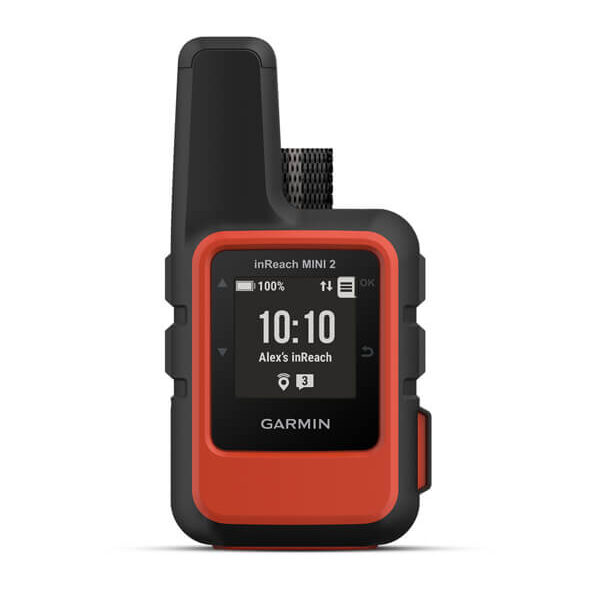
| Garmin inReach Mini 2 | Iridium | Yes, on the device or through the Garmin Messenger app | Yes, Garmin’s 24-hour response center | No | Up to 14 days at a 10-minute tracking interval with full sky view; up to 30 days at 30 minutes | 3.5 oz (100 g) | Yes |
| Garmin inReach Messenger | Iridium | Yes, on the device or through the Garmin Messenger app | Yes, Garmin’s 24-hour response center | No | Up to 28 days on default settings | 4 oz (114 g) | Yes |
| SPOT X | Globalstar | Yes, built-in keyboard or the SPOT X app | Yes, 24/7 search and rescue services | No | 240 hours (10 days) in 10-minute tracking mode | 7.0 oz (198.4 g) | Yes |
| SPOT Gen4 | Globalstar | No; one-way check-in, custom message, help and SOS | Yes, FocusPoint International | No | 1,250 check-in or custom messages on one set of four AAA lithium batteries | 5 oz (142 g) | Yes |
| Inmarsat IsatPhone 2 | Inmarsat L-band (Viasat) | SMS and email | Assistance button sends GPS position to a preset number; monthly plans include 24/7 emergency assistance | Yes | Up to 8 hours talk time, up to 160 hours standby | Not published on the maker’s page | Yes |
Garmin and SPOT rate the messengers by tracking interval, a location sent every 10 minutes; a device that only sends a check-in twice a day lasts far longer than the rated figure, and one left tracking under tree cover lasts less. Garmin’s own spec sheet says moderate tree cover cuts the Mini 2’s 14-day figure to about 4.
Garmin inReach Mini 2: The Top Pick
Garmin rates the Mini 2 at up to 14 days at a 10-minute tracking interval with a full sky view and up to 30 days at a 30-minute interval, charged over USB-C. It weighs 3.5 ounces, is water-rated to IPX7, and carries a sunlight-readable screen, a compass, waypoints, TracBack to retrace a route, and two-way messaging to phone numbers, email and other inReach devices. The SOS button sends your location to Garmin’s response center, staffed 24 hours a day, which messages back and forth during the rescue. Our inReach Mini 2 review covers the plans and the setup. Listing: Garmin inReach Mini 2 on Amazon.
Garmin inReach Messenger: The Communication-First Option
The Messenger is Garmin’s answer for the household that wants the texting and the SOS without the navigation. It runs on the same Iridium network and reaches the same response center, Garmin rates it at up to 28 days of battery on default settings, and it weighs 4 ounces in a 3.1-by-2.5-inch body rated IPX7. Two features set it apart: it works with or without a phone, with on-device messaging as the fallback, and its safety-charging mode lends a dead phone enough charge to send a message through the app. Our inReach Messenger review goes through it in detail. Listing: Garmin inReach Messenger on Amazon.
SPOT X: The One With a Keyboard
The SPOT X is the messenger for someone who does not want to depend on a phone at all. It has a built-in keyboard and its own dedicated U.S. mobile number, so a family member can text it directly, and it runs on the Globalstar network with Bluetooth to the SPOT X app for people who prefer the phone. SPOT rates the rechargeable battery at 240 hours, 10 days, in 10-minute tracking mode with a full charge and a clear sky; it weighs 7 ounces and is rated IP67, submersible to a meter for 30 minutes. Our SPOT X review covers what the keyboard is like to use. Listing: SPOT X on Amazon.
SPOT Gen4: The One-Way Beacon
The Gen4 is in this table as the reference point for what one-way means. It sends four kinds of message over Globalstar, a check-in, a custom message, a help request and an SOS, each to contacts set up in advance, and it cannot receive anything back. It runs on four AAA lithium cells, which SPOT rates at 1,250 check-in or custom messages per set, so there is nothing to recharge and a spare set in the kit doubles the life. It weighs 5 ounces and is rated IP68 against dust and water. For a prepper the one-way limit is the deciding factor: your contacts learn you are alive, and you learn nothing. We do not link a listing for the Gen4 because it has no featured Amazon offer as of this writing; SPOT’s own page carries the specs and availability.
Satellite Phone Alternative: IsatPhone 2
The IsatPhone 2 is a satellite phone on the Inmarsat L-band network, now operated by Viasat, and the only device here that makes a voice call. Viasat rates it at up to eight hours of talk time and up to 160 hours of standby, and adds SMS and email, GPS tracking, an assistance button that sends your position to a preset number, and an alert for incoming calls with the antenna stowed. Viasat states up to 99.9 percent coverage in all but the most polar latitudes, and gives the same 99.9 percent figure for network availability. The maker’s page calls it dust, splash and shock resistant without an IP rating, and publishes no weight. Our IsatPhone 2.1 review covers the kit and the call quality. Listing: Inmarsat IsatPhone 2.1 kit on Amazon.
Which One for Which Reader
- One device for the storm and for the trail: the Garmin inReach Mini 2, with the compass and TracBack you will use in the off season.
- The family check-in and the SOS, nothing else: the Garmin inReach Messenger, with the safety-charging mode as a bonus for a dying phone.
- No phone in the plan at all: the SPOT X and its keyboard, for the relative who will not pair an app.
- A budget beacon for a household that only needs to say “we are fine”: the SPOT Gen4, knowing nobody can answer.
- A voice is required: the IsatPhone 2, with a messenger as the everyday link.
Whichever you pick, it belongs in the family communication plan with a rule for who carries it and when the SOS is used. Our emergency communications guide covers the check-in routine, and Evacuate or Shelter in Place? covers the decision the first message usually reports.
Common Questions
Do satellite messengers work indoors or in a car?
Not reliably. Every maker here says the device needs a clear view of the sky. A porch, a driveway or an open window on the sky side of the house usually works after the storm; a stairwell, a garage or a car under a carport does not.
Can I pause the subscription when hurricane season ends?
Most plans can be suspended or moved to a lower tier in the off season; the makers’ sites list the current options. The risk is forgetting to turn it back on. Tie the reactivation to the June 1 start of the season and test the device with a real message the same day.
Is a satellite messenger better than a satellite phone?
For most families, yes. A messenger is smaller, its battery lasts weeks instead of hours, and a text to an out-of-area contact usually does the job. A phone wins when a conversation is required or the person on the other end will not use an app.
Bottom Line
Get a two-way messenger on a network that covers where you live and where you would evacuate to, keep its subscription active through the season, and write it into the family plan. The Garmin inReach Mini 2 is the one we would buy first: global Iridium coverage, a 24-hour response center behind the SOS, two-way texting with or without a phone, and navigation you will use outside hurricane season.
Updated 2026-11-01: corrected the IsatPhone 2 coverage wording to match Viasat’s statement.
Some links on this page are Amazon affiliate links. If you buy through them, Ultimate Prepper’s Guide may earn a small commission at no extra cost to you.