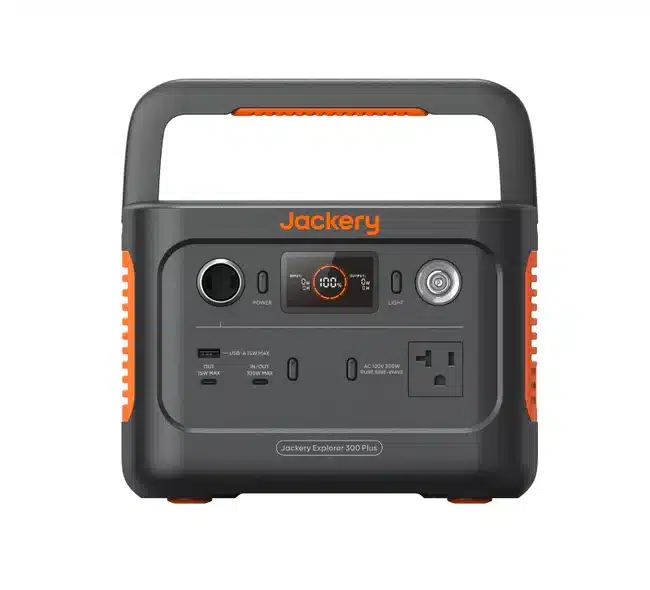
If a storm knocks out your power for a night or two and you just need to keep your phone charged, run a CPAP for one sleep cycle, or power a small fan, the Jackery Explorer 300 Plus is worth a serious look. At under 9 pounds and roughly $200–$279, it’s the kind of unit you grab off the shelf and toss in the car when a mandatory evacuation order drops. It’s not going to run your refrigerator through a 5-day outage – but it was never designed to. For what it is, it’s a capable, well-built little unit.
What It Does
The Explorer 300 Plus packs a 288Wh LiFePO4 battery – which matters a lot. LiFePO4 chemistry is more thermally stable than older lithium-ion cells and, importantly, it’s rated for significantly more charge cycles before the battery starts degrading. Jackery claims 3,000+ cycles to 80% capacity, which means this thing should still be useful a decade from now if you treat it right.
The AC output is 300 watts continuous, which is enough to run small appliances – a CPAP machine without the humidifier (typically 30–60W), a box fan (40–100W), LED lights, phone and laptop chargers, and smaller medical devices. It won’t run a window AC unit or a full-size refrigerator. Don’t expect it to.
Ports include: 1 standard AC outlet, a USB-C port (up to 60W), a USB-A port, and a 12V car outlet. That covers most real-world needs in an outage scenario. Charge time from a wall outlet is impressively fast – around 1.8 hours to full. That’s legitimately quick for a unit in this class. You can also charge it via solar panels (sold separately) or your car’s 12V outlet, which is useful if you’re sheltering in place after a storm and utility power is weeks out.
Weight is 8.3 pounds. That’s light enough that it doesn’t feel like a commitment to move it around the house or throw it in a vehicle.
Why It Belongs in Your Hurricane Kit
Living on the Gulf Coast, power outages after a hurricane are basically guaranteed. Even a glancing blow from a Cat 1 can leave neighborhoods dark for 24–72 hours. The question isn’t if you’ll lose power – it’s whether you’re ready when it happens.
Here’s where the 300 Plus earns its spot:
- CPAP users: If you or someone in your household uses a CPAP, this is one of the most practical use cases for a small power station. A standard CPAP without a humidifier draws around 30–60W. At that draw rate, the 300 Plus can run it for 4–8 hours on a single charge – enough for a full night’s sleep. Recharge it the next morning from your car if grid power isn’t back yet.
- Phone and device charging: In an evacuation scenario, keeping your phone alive is critical for emergency alerts, navigation, and family communication. The 300 Plus can charge a smartphone 15–20 times on a single charge.
- Fan power during a sweltering outage: Anyone who’s been in a Florida home in August with no AC knows it gets dangerous fast. A box fan on low pulls around 40–50W. The 300 Plus can run one for 4–5 hours before needing a recharge.
- Evacuation bag power: Unlike a big 2,000Wh unit that takes two people to lift, this one goes in the backseat without a second thought. If you’re heading inland to a shelter or a family member’s house, this comes with you.
Based on the spec sheet and owner reviews, the unit handles Gulf Coast heat reasonably well, though like any battery-based device it prefers not to be left baking in a hot car all day.
Honest Limitations
1. 288Wh is a real ceiling. This is not a whole-home or even whole-room solution. If you’re hoping to run a mini-fridge, forget it – a typical compact refrigerator pulls 100–150W, and the 300 Plus would drain in 2–3 hours at that load, assuming it can even sustain that draw without tripping the inverter. If keeping food cold is your priority, you need a unit in the 1,000Wh+ range, like the Jackery 1000 or my personal go-to, the Anker SOLIX F2000.
2. Single AC outlet. You get one AC port. If you need to run multiple AC-powered devices simultaneously, you’d need a power strip – and then you’re still limited to that 300W total. It’s a minor inconvenience but worth knowing before you buy.
3. 300W inverter won’t handle surge loads well. Some appliances – especially those with motors – pull a surge of power when they start up. The 300W continuous rating means devices with high startup surges may trip the unit’s protections. Check the wattage of anything you’re planning to run and add a buffer.
How It Stacks Up
vs. Jackery Explorer 240: The older 240 used a lithium-ion battery and had a shorter cycle life. The 300 Plus costs a bit more but gives you LiFePO4 chemistry, slightly more capacity, and faster charging. In 2024, the 300 Plus is the clear upgrade. There’s not much reason to go with the 240 anymore.
vs. Anker SOLIX C300: Anker’s comparable entry-level unit is similarly priced and also uses LiFePO4. The Anker has slightly more ports and a built-in flashlight, which is genuinely useful during outages. The Jackery charges a bit faster (1.8 hrs vs. roughly 2 hrs). They’re honestly neck-and-neck at this price point – it comes down to brand preference and what’s on sale when you’re buying. If you’re already in the Jackery ecosystem with solar panels, stick with Jackery.
For context: I personally run the Anker SOLIX F2000 as my primary hurricane backup – it handles the fridge, the fans, and the CPAP simultaneously. The 300 Plus would be a solid secondary unit or a first step for someone who’s not ready to spend $1,500+ on a full setup.
Who Should Buy This
Buy it if: You’re a renter or new homeowner looking for an affordable first power station. You primarily need it for device charging, CPAP power, or fans during a 1–2 day outage. You want something lightweight enough to take on a camping trip or keep in your car. You’re building toward a full prepper power setup and need a grab-and-go secondary unit.
Skip it if: You need to power a refrigerator, window AC, or multiple large appliances. You’re in a rural area where outages routinely last 5–10 days – you need significantly more capacity. You have a household full of powered medical devices. In those cases, look at the Jackery 1000 Plus or step up to something in the 2,000Wh range.
Common Questions
Can the Jackery Explorer 300 Plus run a CPAP all night?
Yes, in most cases. A CPAP without a humidifier typically draws 30–60 watts. At that load, the 300 Plus (288Wh) will last 5–8 hours, which covers a standard sleep cycle. If you run the heated humidifier, power draw jumps significantly and you may only get 3–4 hours. Turn the humidifier off during outages to extend runtime.
Can I charge it with solar panels?
Yes. Jackery sells compatible solar panels – the SolarSaga series is designed to pair with this unit. From owner reviews, a 100W panel in good direct sunlight will top it off in 3–4 hours. That matters a lot if the grid is down for multiple days post-hurricane and you’re relying on sun power to keep cycling the unit.
Is LiFePO4 actually better for long-term storage?
For emergency preparedness, yes. LiFePO4 batteries hold a charge longer when sitting unused, are safer in hot environments (relevant on the Gulf Coast), and last for far more charge cycles. If you charge this thing up in June and it sits on a shelf until a September storm, LiFePO4 chemistry handles that better than standard lithium-ion.
What can I NOT run on the Explorer 300 Plus?
Anything that draws more than 300W continuously is off the table: window AC units, full-size refrigerators, microwaves, electric kettles, hair dryers, space heaters. These appliances pull far more than 300W and will immediately trip the unit’s overload protection. Stick to low-wattage devices and you’ll be fine.
Bottom Line
The Jackery Explorer 300 Plus is a solid, lightweight, entry-level power station for preppers who are just getting started or need a portable secondary unit. The LiFePO4 battery and fast charging make it genuinely better than older options in this price range. It won’t carry your whole household through a major storm, but it’ll keep your phone alive, your CPAP running, and your fan spinning – and sometimes that’s exactly what you need.
Some links on this page are Amazon affiliate links. I only recommend gear I personally own – if you buy through my link, I may earn a small commission at no extra cost to you.