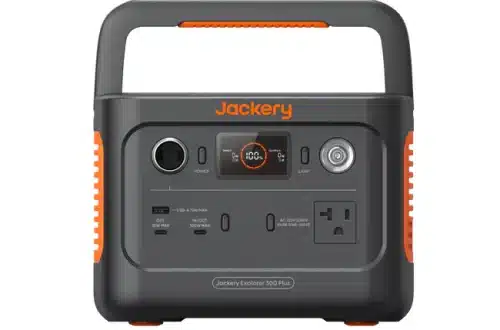
The Jackery Solar Generator 300 is one of the most practical small power stations on the market – not because it’ll run your refrigerator, but because it’ll keep your phone, laptop, CPAP, and fan alive when the grid goes down and you need it most. If you’ve ever sat in a dark house two days into a storm outage wishing you had something – anything – to charge your devices, this is the answer that fits in your closet and costs under $300.
What It Does
The Jackery 300 is a 293Wh lithium battery pack paired with a pure sine wave inverter that puts out 110V AC at up to 300 watts continuous. That matters because pure sine wave output is safe for sensitive electronics – your CPAP, camera gear, or laptop charger won’t complain. It has two standard AC outlets, two USB-A ports, and a USB-C port, so you can run or charge multiple devices at once without an adapter shuffle.
It charges four ways: standard wall outlet (fastest, around 2 hours), 12V car adapter, the optional solar panel, or a combination of solar and AC simultaneously. The display is simple – battery percentage, input/output wattage, and estimated runtime or charge time. No app required, no Bluetooth setup, just turn it on and plug in.
Why It Belongs in Your Kit
Down here on the Gulf Coast, a 3-day power outage isn’t a hypothetical – it’s a Tuesday after a named storm. The Jackery 300 isn’t going to run your window AC unit or keep your full-size fridge cold, but it will charge your phones, keep a small fan running through the night, power a LED work light during cleanup, and top off a rechargeable lantern. That’s the real use case: comfort and communication, not whole-home backup.
For camping, it’s genuinely useful. Run a small electric cooler, charge camera batteries, power a portable projector for movie night at the campsite. At 7.1 lbs, it fits in the back seat of a truck without eating into your gear space. I’ve had mine tucked behind my passenger seat through a couple of hurricane seasons now, and it’s come out for everything from campsite coffee makers to keeping my weather radio charged during a tropical storm watch.
The solar charging angle is worth talking about plainly: the included 100W solar panel will recharge the unit in roughly 4–5 hours of direct sun. In Florida, that’s usually workable. In the Pacific Northwest in November, less so. But as a long-term outage strategy – charge overnight from the grid when power’s on, top up via solar during the day – it’s a solid two-pronged approach.
Honest Limitations
293Wh goes faster than you think. A 45W laptop will drain it in about 5 hours. A small portable fridge running continuously will eat through it in 3–4 hours. If your plan involves anything with a compressor or heating element, you’ll be disappointed. This isn’t a knock on the unit – it’s just the reality of the capacity class.
The 300W continuous output ceiling catches people off guard. Plenty of common appliances – a coffee maker, a hair dryer, a microwave – pull 800–1200W and simply won’t run. Check the wattage on what you want to power before assuming this will cover it.
The battery will degrade over time, and Jackery rates it at 500 charge cycles to 80% capacity. That’s reasonable for the price point, but it means if you’re cycling it heavily – multiple outages per year plus camping trips – you’ll see capacity decline over a few years. It’s not a forever unit; budget for eventual replacement.
How It Stacks Up
If you need more headroom, the EcoFlow Delta 2 is my mid-tier pick – it triples the capacity and charges significantly faster, which matters a lot in an extended outage. For serious off-grid or whole-home emergency backup, the Anker SOLIX F2000 is a different category of solution entirely. The Jackery 300 fits between those and nothing – it’s for people who want real backup power without the bulk, cost, or complexity of a larger station. The Goal Zero Yeti 200X is a comparable competitor at a similar price, but the Jackery wins on AC output wattage and available solar panel ecosystem.
Who Should Buy This
This is a great fit for campers, RV travelers, and coastal or storm-prone households that want a lightweight, simple power backup for devices and small appliances. If your outage priorities are phones, lights, a fan, and maybe a small CPAP – this covers it without overbuying.
Skip it if you need to run anything with a heating element, a compressor, or sustained high-wattage draw. Also skip it if you’re in a zone that routinely sees week-long outages – the capacity just isn’t there for that level of demand without near-constant solar recharging.
Common Questions
Can it run a CPAP machine overnight?
Yes, with some caveats. A standard CPAP without a heated humidifier draws roughly 30–60W. At that rate, the Jackery 300 should get you through a full 8-hour night with capacity to spare. Turn off the humidifier if yours has one – that’s the power hog. Using the DC output instead of AC will also extend runtime.
How long does it take to recharge via solar?
With the included 100W panel in good direct sunlight, expect a full recharge in about 4–5 hours. Partial cloud cover or panel angle will extend that. In Florida summer conditions, mid-morning to early afternoon is your best solar window – position accordingly and you can usually get a full charge on a sunny day.
Can I charge it in my car while driving?
Yes, via the 12V car port, but it’s slow – roughly 14–16 hours from empty. It’s better used as a trickle top-off during a long drive than as a primary charging method. Useful for keeping it from sitting at zero between trips, not for fast recovery.
Is the pure sine wave output actually necessary?
For most simple devices like phone chargers and LED lights, no. But for anything with a motor, medical equipment like a CPAP, or sensitive electronics, pure sine wave is genuinely better – it produces cleaner power that won’t cause buzzing, overheating, or efficiency loss in compatible devices. The fact that Jackery includes it at this price point is a legitimate plus.
Bottom Line
The Jackery Solar Generator 300 is a well-built, honest performer in a specific capacity class. It won’t replace a whole-home generator, but for keeping your critical devices alive through a storm outage or powering a campsite, it’s hard to beat at the price. Check current price on Amazon.
Some links on this page are Amazon affiliate links. I only recommend gear I personally own – if you buy through my link, I may earn a small commission at no extra cost to you.