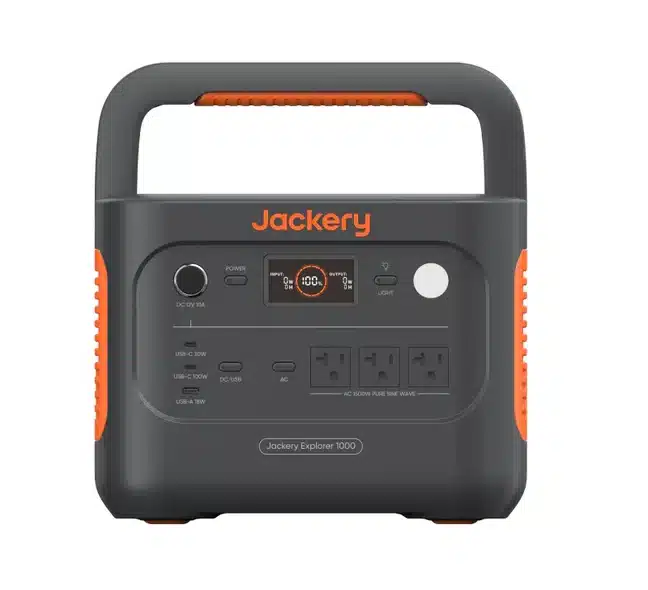
When the power goes out after a Gulf Coast storm, you’ve got maybe 4 hours before the fridge becomes a problem, 8 hours before people start getting uncomfortable, and by day two you’re making decisions you really don’t want to make. A reliable solar generator isn’t a luxury down here – it’s damage control. The Jackery Explorer 1000 v2 sits in a sweet spot that a lot of people are looking at right now: under $900, over 1,000Wh, and light enough that one person can actually move it around the house. Here’s an honest look at whether it delivers.
What It Does
The Explorer 1000 v2 runs on a 1,070Wh LiFePO4 battery – that’s lithium iron phosphate, which matters because LiFePO4 chemistry is significantly more stable and longer-lasting than older lithium-ion cells. Jackery rates this battery for 4,000 charge cycles, which in practical terms means if you cycle it once a week, it’ll still be at 80% capacity in about a decade. That’s a big deal for a piece of gear you’re hoping never to need but can’t afford to have fail when you do.
Output is 1,500W continuous with a 3,000W surge. That surge capacity is what lets it handle appliances with compressors – refrigerators, window AC units – that need a spike of power at startup before settling into normal draw. Three AC outlets give you real flexibility, and the dual 100W USB-C ports mean you can fast-charge laptops and devices without burning one of your AC slots.
Charge time is where this unit genuinely stands out. Emergency fast-charge mode gets it from zero to full in about 1 hour via AC wall outlet. Standard charge is around 1.7 hours. Compare that to older units in this class that took 6–8 hours to charge and you start to understand why this matters – you might have a window of grid power before a storm hits, and you want that thing full before the outage starts. Check current price on Amazon.
At 23.8 lbs, it’s genuinely portable. One hand, no help needed. That’s not nothing when you’re moving it from the living room to the bedroom to the garage depending on what you’re running.
Why It Belongs in Your Hurricane Kit
Let’s talk real numbers for real Gulf Coast scenarios.
Keeping the fridge running: A typical full-size refrigerator draws 100–400W when the compressor cycles. At an average of around 150W, you’re looking at roughly 6–7 hours of fridge time per full charge. That’s not all-day, but it’s enough to get you through the worst of the heat if you’re disciplined about opening it – and it buys time for solar panels to recharge the unit during daylight hours.
CPAP machines: A CPAP without a humidifier draws somewhere between 30–60W. On a 1,070Wh battery, you’re getting multiple nights of sleep comfortably before you need to recharge. If someone in your household depends on one, this is a non-negotiable use case, and the Explorer 1000 v2 handles it with room to spare.
Fans during a 3-day outage: In August on the Gulf Coast, no power means no air movement and that gets dangerous fast, especially for elderly family members. A box fan runs around 50–100W. You could run a fan continuously for 10+ hours on a single charge while still keeping other devices topped off.
Evacuation power: At 23.8 lbs, this goes in the back seat of your car without a second thought. Charged up before you leave, it’ll keep phones, tablets, a CPAP, and small appliances running for the duration of a hotel stay or a few days at a family member’s place further inland.
Pair it with a Jackery SolarSaga panel and you’ve got a system that can trickle-recharge during daylight even if the grid stays down for a week. Based on the spec sheet and owner reviews, most people are getting solid results with 200W of solar input for meaningful daytime recharging.
Honest Limitations
It won’t run central AC. I want to be direct about this because people ask. A central air system pulls 3,000–5,000W. This unit tops out at 1,500W continuous. It’s not going to happen. A small window unit (5,000 BTU) draws around 500W and might work if your surge doesn’t exceed the 3,000W peak, but runtime will be short. This is a comfort and essentials unit, not a whole-home solution.
The app connectivity is hit or miss. From owner reviews across multiple platforms, the Jackery app gets mixed feedback. Some people find it useful for monitoring charge levels remotely; others report connectivity issues and find it easier to just read the display. Not a dealbreaker, but don’t factor it in as a key feature.
Price fluctuates significantly. The Explorer 1000 v2 has been listed anywhere from $699 to $899 depending on sales, bundles, and time of year. Jackery runs frequent promotions, so if you’re not in immediate need, it’s worth watching the price. That said, buying it at $899 right before hurricane season still beats not having it at all. View on Amazon to check today’s price.
How It Stacks Up
vs. Anker SOLIX F2000: I own the F2000 and it’s in a different category – 2,048Wh, 2,200W output, and priced around $1,500–$2,000. If you need to run a chest freezer plus a CPAP plus charging for a full household for multiple days, the F2000 makes sense. But it’s nearly twice the price and weighs significantly more. The Explorer 1000 v2 is the smarter buy if your budget is under $900 or you need true portability.
vs. EcoFlow River 2 Pro: The River 2 Pro has 768Wh and an 800W output – lighter and cheaper, but noticeably less capacity and power headroom. If you’re solo or have minimal needs, it works. But for running a fridge or any higher-draw appliance, the extra headroom in the Explorer 1000 v2 is worth the price difference.
Who Should Buy This
Buy it if: You’re a Gulf Coast homeowner who wants a capable, genuinely portable backup power unit for hurricane season. You have a CPAP user in the house. You want something you can move around easily and take in the car if you evacuate. You don’t need to run central AC or heavy power tools.
Skip it if: You need to power a full household for more than a day or two without solar recharging – in that case, look at a higher-capacity unit like the SOLIX F2000 or EcoFlow DELTA Pro. Or if your power needs are truly minimal (just phones and a light or two), a smaller, cheaper unit will do the job without overspending.
Common Questions
Can the Jackery Explorer 1000 v2 run a refrigerator?
Yes, with caveats. A standard fridge draws 100–400W when cycling. The Explorer 1000 v2 handles that load comfortably within its 1,500W output. Runtime per charge will vary – expect 5–8 hours depending on your fridge’s efficiency and how often the door opens. Pair with solar panels to extend that meaningfully.
How long does it take to charge?
About 1 hour in fast-charge/emergency mode from a wall outlet. Around 1.7 hours at standard AC charge speed. Solar input varies by panel wattage and sunlight conditions – with 200W of panels in good sun, expect roughly 5–6 hours from empty.
Is LiFePO4 actually better for this use case?
For emergency prep, yes. LiFePO4 is more thermally stable (important in Florida heat), holds up better to partial charge cycles, and lasts far longer – 4,000 cycles vs. the 500–1,000 you’d get from older lithium-ion units. It costs a bit more upfront but you’re not replacing it in three years.
Can I use it while it’s charging?
Yes. The Explorer 1000 v2 supports pass-through charging, meaning you can run devices from it while it’s plugged into the wall or solar panels. This is useful during the window before a storm when you want it topped off but still need to run something.
Bottom Line
The Jackery Explorer 1000 v2 is a legitimate, well-built option for Gulf Coast hurricane prep – enough capacity to matter, fast enough charging to actually be useful, and light enough to go wherever you go. It’s not a whole-home solution, but for keeping essentials running and your household safe through a multi-day outage, it earns its price. Check current price on Amazon.
Some links on this page are Amazon affiliate links. I only recommend gear I personally own – if you buy through my link, I may earn a small commission at no extra cost to you.