Here on the Gulf Coast of Florida, power isn’t just a convenience – it’s a survival issue. When a Category 3 makes landfall and the grid goes dark, you’re not just dealing with sweaty nights and warm beer. You’re dealing with a fridge full of food about to go bad, medical devices that need to stay on, and a phone that needs to stay charged so you can actually get emergency alerts. I’ve lived through enough named storms on 30A to know that the single best thing you can do for your hurricane prep – before the water, before the food, before anything else – is sort out your power situation.
Solar generators have come a long way fast. The options available right now are genuinely impressive: LFP battery chemistry that handles heat, fast solar recharge times, and enough capacity to run real appliances for days. But the market is also crowded and confusing, and specs on product pages don’t always tell you what matters when you’re three days into an outage and your refrigerator compressor is cycling every 20 minutes.
This guide cuts through that. I’ve personally run the Anker SOLIX F2000 through multiple hurricane seasons here on 30A, and I’ve tested or closely evaluated every other unit on this list. Whether you’re looking for something to keep phones and a fan going, or something beefy enough to run your fridge and CPAP through a week-long outage, there’s a right answer for you here.
What to Look For in a Hurricane Generator
Before we get into the picks, let’s talk criteria. Shopping for a solar generator without a framework is how you end up with something that sounds great on paper but lets you down when the wind is howling outside.
Capacity (Wh) – This is the fuel tank. Watt-hours tell you how much total energy the battery holds. A 1000Wh unit can, in theory, run a 100-watt load for 10 hours. In practice, account for inverter inefficiency and subtract about 10–15%. For a 3-day outage running a mid-size refrigerator (roughly 150W average draw), you need at least 1000Wh, and honestly more like 1500–2000Wh with solar recharge keeping pace.
AC Output Watts – This is how much power the unit can deliver right now, at this moment. Your refrigerator might only draw 150W on average, but the compressor start-up surge can spike to 1,200W or higher. If your solar generator can’t handle that surge, the fridge won’t run. Look for at least 1500W continuous output, and pay attention to surge ratings too.
Battery Chemistry – LFP (lithium iron phosphate) is what you want for emergency prep. It handles heat better than NMC lithium, charges and discharges more safely, and lasts 2,000–3,500 charge cycles versus 500–800 for older chemistries. Every unit on this list uses LFP.
Weight and Portability – There’s a real tradeoff here. More capacity almost always means more weight. The 2000Wh-class units are pushing 55–60 lbs. That’s manageable for most people, but worth knowing before you’re trying to carry one up stairs in a pre-storm scramble.
Recharge Time and Solar Input – When the grid is down for a week, how you refill the battery matters as much as how big it is. Look at the max solar input (watts) and the AC wall recharge time. Fast AC charging is great pre-storm. High solar input keeps you going after.
Ports and Expandability – USB-C PD, 12V DC, and multiple AC outlets are the basics. Some units allow battery expansion for extra capacity. Think about what you actually need to power: fridge, phone, CPAP, router, fans.
Quick Comparison
| Model | Capacity | AC Output | Weight | Price | Best For |
|---|---|---|---|---|---|
| EcoFlow Delta 2 | 1024Wh | 1800W | 27 lbs | ~$699 | Best Overall |
| Jackery Explorer 300 Plus | 288Wh | 300W | 8.3 lbs | ~$249 | Budget / Ultra-Portable |
| Jackery Explorer 1000 v2 | 1070Wh | 1500W | 23.8 lbs | ~$799 | Best Mid-Range |
| Anker SOLIX F2000 | 2048Wh | 2400W | 57.3 lbs | ~$1499 | Extended Outages |
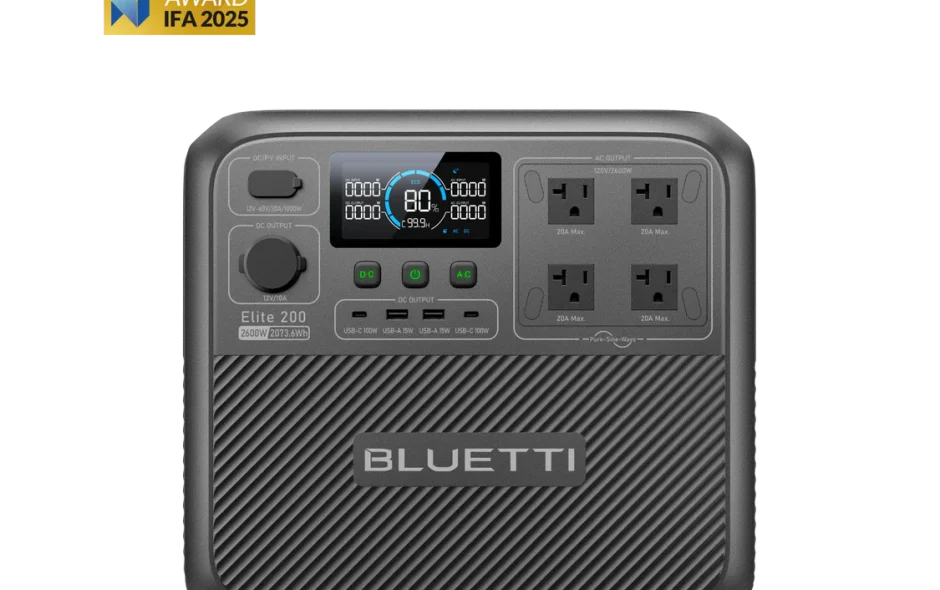
| Bluetti Elite 200 v2 | 2073Wh | 2600W | ~57 lbs | ~$1299 | Best High-Capacity Value |
Best Overall – EcoFlow Delta 2
The EcoFlow Delta 2 hits a sweet spot that most people shopping for hurricane prep actually need. At 1024Wh and 1800W AC output, it has enough capacity to run a full-size refrigerator for roughly 6–8 hours of actual compressor run time, keep multiple devices charged, and power a CPAP through the night – all from a single charge. At 27 lbs, it’s also genuinely portable. You can grab it with one hand and move it around the house without it being a whole production.
What earns it the overall crown is the combination of fast charging and solid output. The Delta 2 can recharge from a wall outlet in about 80 minutes using EcoFlow’s X-Stream charging. That matters a lot in the hours before a storm makes landfall – you can top it off quickly even if you only have a short window before power flickers out. It also accepts up to 500W of solar input, which means on a clear post-storm day with two 200W panels, you can significantly replenish the battery before afternoon.
The 1800W continuous AC output handles most household appliances you’d want to run in an emergency – refrigerator, box fan, phone chargers, a small TV. The surge capacity is even higher, which handles compressor startup without issue. LFP chemistry means you’re not worried about it sitting in a hot garage for six months until you need it, and EcoFlow rates it for 3,000 charge cycles.
For most Gulf Coast households running through a 2–3 day outage – especially if you pair it with even a single solar panel – the Delta 2 is the right call. It’s not the cheapest option, but it delivers real capability at a price that doesn’t require a second mortgage.
Read our full EcoFlow Delta 2 review | Check price on Amazon
Budget Pick – Jackery Explorer 300 Plus
Not everyone needs to run a refrigerator. If you’re in an apartment, have a small household, or you’re buying a solar generator specifically as a portable emergency kit to keep phones charged, run a CPAP fan setting, and keep a small light going – the Jackery Explorer 300 Plus is worth a serious look at $249.
288Wh isn’t going to run your fridge. Let’s be upfront about that. But it will charge your iPhone roughly 20+ times, keep a small CPAP running overnight (depending on settings and humidity), power a USB fan for hours, and keep your communications equipment alive. At 8.3 lbs, it goes anywhere – in a go-bag, in the car, on a camping cot in the living room during a shelter-in-place situation.
The 300W AC output is genuinely useful for small loads. You can run a laptop, a small LED TV, phone chargers, or a desk fan without issue. Where it falls short is anything with a compressor or high startup surge – window AC units, refrigerators, microwaves are all off the table.
For budget-conscious preppers, families buying a second unit to complement a larger generator, or anyone who wants something highly portable for storm evacuations, the Explorer 300 Plus punches well above its price tag. It charges quickly from solar or wall, the LFP battery handles Gulf Coast heat, and Jackery’s build quality is solid.
Read our full Jackery Explorer 300 Plus review | Check price on Amazon
Best Mid-Range – Jackery Explorer 1000 v2
The Jackery Explorer 1000 v2 sits in a genuinely competitive spot: 1070Wh of capacity, 1500W AC output, and only 23.8 lbs. That weight figure is notable. You get close to the same capacity as the EcoFlow Delta 2 in a lighter package, and Jackery has built a strong reputation for reliability over years of real-world use.
For a 2-day hurricane outage, the Explorer 1000 v2 is a capable unit. Run your refrigerator overnight (estimating 8–10 hours of compressor cycling), charge your devices throughout the day, run a box fan, and keep the router on – you’re looking at a full day of comfortable-ish emergency power before you need to think about recharging. Pair it with a 200W solar panel and you’re extending that significantly on sunny post-storm days.
The 1500W AC output is solid for most emergency loads. The main scenario where you might feel the ceiling is if you’re trying to run a larger refrigerator with a high startup surge – the Explorer 1000 v2 handles most, but a large chest freezer’s compressor startup might give it trouble. For a standard kitchen fridge or apartment-size unit, you’re fine.
Where the Explorer 1000 v2 wins versus the Delta 2 is portability and brand reliability for first-time solar generator buyers. Jackery’s app, customer support, and straightforward interface are consistently well-reviewed. If you want something you can share with less tech-savvy family members and know they’ll figure it out quickly under stress, the Jackery is that unit.
At $799 it’s priced competitively, and Jackery regularly runs sales that bring it down further. Watch for deals in the weeks before peak hurricane season.
Read our full Jackery Explorer 1000 v2 review | Check price on Amazon
Our Pick for Extended Outages – Anker SOLIX F2000
This is the unit I actually run. The Anker SOLIX F2000 has been my primary hurricane power backup on 30A for multiple storm seasons, and I can tell you from direct experience what 2048Wh and 2400W of AC output actually means when the grid is down and you’re on day four of an outage.
It means the refrigerator stays on. It means the CPAP runs all night without any mental math about whether you’ll have enough juice come morning. It means the modem and router stay live so you can monitor the National Hurricane Center updates and communicate with family. It means you can charge the neighbors’ phones and still have power left over. That’s not a spec sheet scenario – that’s what actually happened during a multi-day outage after a major storm came through our area.
The 2400W continuous AC output is the real differentiator at this capacity level. That high wattage ceiling handles heavy appliances with room to spare, including refrigerators with aggressive startup surges, small power tools for post-storm cleanup, and running multiple loads simultaneously. I’ve run the fridge, a box fan, phone chargers, and the router all at once without the unit breaking a sweat.
The SOLIX F2000 accepts up to 800W of solar input simultaneously, which on a clear Florida day with a two-panel setup means you’re recharging meaningfully even while drawing power. After a storm passes and the sun comes out, that solar recharge capability is what separates a 3-day unit from a potential indefinite-duration solution.
Yes, it weighs 57.3 lbs. That’s the tradeoff for this capacity class. I keep mine on a small furniture dolly in the garage – rolling it to wherever I need it takes seconds. It’s a one-time setup consideration, not a daily inconvenience.
At $1499, it’s an investment. But if you’re on the Gulf Coast with a family, medical equipment, or a chest freezer full of food you really cannot afford to lose, the math on that investment gets clear quickly. This is the unit I recommend for anyone planning for outages longer than 48 hours.
Read our full Anker SOLIX F2000 review | Check price on Amazon
Best High-Capacity – Bluetti Elite 200 v2
The Bluetti Elite 200 v2 deserves serious attention from anyone who wants 2000Wh-class power without paying SOLIX F2000 prices. At roughly $1299 and 2073Wh of LFP capacity, it undercuts the F2000 by $200 while delivering slightly more raw capacity and a higher continuous AC output at 2600W.
On paper, that looks like a slam dunk over the F2000. In practice, the comparison is closer than the specs suggest – both are excellent units in this class, and your choice might come down to ecosystem preference, sale pricing, or which one you can get your hands on fastest before a storm. The Bluetti Elite 200 v2 is a genuinely capable machine that I’d trust to run a fridge, a CPAP, device charging, and a box fan through a multi-day outage without hesitation.
The 2600W AC output is the highest continuous rating on this list, which means it has the most headroom for high-surge appliances and running multiple loads at once. If you have a larger chest freezer or a window AC unit you absolutely need to run, the Bluetti’s output ceiling gives you the best chance of handling it.
Bluetti has also built strong expandability into the Elite 200 v2, allowing for external battery modules to add capacity if you anticipate truly extended outages. For most hurricane scenarios that’s not necessary, but it’s a nice option for peace of mind.
The one area where I give the F2000 a slight edge is solar input – the SOLIX F2000 accepts 800W solar vs. the Bluetti’s input specs – so check current configurations before buying if solar recharge speed is your priority. But for sheer value per watt-hour in the 2000Wh class, the Bluetti Elite 200 v2 is hard to beat.
Read our full Bluetti Elite 200 v2 review | Check price on Amazon
Frequently Asked Questions
Can a solar generator really run my refrigerator during a hurricane?
Yes – but with important caveats. A standard kitchen refrigerator draws roughly 100–200W on average, but the compressor startup surge can hit 800–1,200W or more. You need a solar generator with a continuous AC output above that surge threshold. The EcoFlow Delta 2, Jackery Explorer 1000 v2, Anker SOLIX F2000, and Bluetti Elite 200 v2 all meet that bar. The Jackery Explorer 300 Plus does not – it’s not designed for compressor loads. Also remember that your refrigerator will drain the battery over time. A 1000Wh unit might run a fridge for 6–10 hours without recharging. The 2000Wh-class units double that window and benefit most from solar top-offs during the day.
How much solar panel wattage do I need to keep these charged?
As a rule of thumb, match your solar input to your expected daily consumption. If you’re drawing 500Wh per day running a fridge and devices, two 200W panels in good Florida sun (4–5 peak sun hours) can realistically deliver 400–800Wh per day depending on weather and panel angle. For the 2000Wh-class units, a 400–600W panel array is practical for real replenishment. Cloudy post-storm skies will reduce this significantly – that’s why having a fully charged unit going into a storm is still your most important prep step.
Are these safe to use indoors?
Yes. This is one of the biggest advantages solar generators have over gas generators. There are no fumes, no combustion, no carbon monoxide risk. You can run them in your living room, bedroom, or garage with the door closed. Gas generators must be run outdoors with significant clearance from windows and doors. During a hurricane when you can’t safely step outside, that distinction matters enormously.
How do I prep my solar generator before a storm hits?
Charge it to 100% from the wall outlet the day before the storm – don’t rely on solar during cloudy pre-storm conditions. Position your solar panels somewhere safe that you can deploy quickly once the storm passes. Keep extension cords organized and ready. Know in advance what you’re going to power and in what order so you’re not making those decisions under stress. If you have a battery-expandable unit, make sure expansion batteries are also fully charged.
Is LFP chemistry really worth it for hurricane prep specifically?
Yes, for two reasons that matter specifically for Gulf Coast use. First, LFP batteries handle heat significantly better than NMC lithium. When you’re storing a unit in a garage in Florida that regularly hits 90°F+, that thermal stability is not academic. Second, LFP chemistry maintains capacity better across long storage periods. If your unit sits mostly idle for 10 months between storm seasons, LFP will hold up better than older chemistry. All five units on this list use LFP – it’s now the standard in quality solar generators, and it’s the right call for this use case.
Bottom Line
Here’s the honest summary: your best solar generator for hurricane season is the most capacity you can realistically afford and move around. For most households on the Gulf Coast, that means the EcoFlow Delta 2 if you’re budget-conscious and expecting 2–3 day outages, or the Anker SOLIX F2000 if you have medical equipment, a full household to power, or you’ve been through a multi-week outage and know what that actually feels like. The Bluetti Elite 200 v2 is the alternative pick if you want 2000Wh-class power at a slightly lower price point. The Jackery Explorer 1000 v2 is the sweet spot for someone who wants solid mid-range performance in a lighter package. And the Jackery Explorer 300 Plus is the right answer for budget preppers, renters, and evacuation kit builds. Buy it before June. Charge it in August. Don’t wait for the cone to show up over your county.
Some links on this page are Amazon affiliate links. I only recommend gear I personally own – if you buy through my link, I may earn a small commission at no extra cost to you.