Disclosure: this post contains Amazon affiliate links. If you buy through them, we may earn a small commission at no extra cost to you.
A boil-water notice after a hurricane assumes you have a stove, fuel and a pot, and a filter assumes you packed one. Purification tablets are the backup for the day neither is true: a foil strip the size of a credit card that turns a quart of questionable tap water into something you can drink, in the glove box, the bug-out bag or the kitchen drawer, with a shelf life measured in years. They are also the most misunderstood item in a water kit, because the tablets differ in what they kill and how long they take, and the label is the only thing that tells you.
This roundup compares four current tablets: Aquatabs 397 mg, the chlorine tablet that treats the largest volume per tablet; Potable Aqua’s iodine tablets, the classic Army-descended kit; Potable Aqua’s chlorine dioxide tablets; and Katadyn’s Micropur MP1. The picks were chosen because they are current, EPA-registered products whose makers publish a label we could read. How much water you need to treat in the first place is in our guide to how much water to store for a hurricane.
How to Choose
Know the four organisms. The CDC groups waterborne germs into bacteria, viruses and two parasites, Giardia and Cryptosporidium. The CDC says chemical disinfectants do not work as well as boiling against the parasites Cryptosporidium and Giardia, that iodine and chlorine tablets kill most germs but will not kill Cryptosporidium, and that chlorine dioxide tablets will kill Cryptosporidium as long as you follow the instructions correctly. That one sentence decides most of this roundup: an iodine or plain chlorine tablet is not a reliable answer to Cryptosporidium, and a chlorine dioxide tablet is a reliable answer only if you give it its full contact time.
Respect the contact time. Every tablet here has a waiting period on its label, and the Cryptosporidium claim on the chlorine dioxide tablets is tied to a 4-hour reaction. If you cannot wait, a filter is the faster tool; our water filter roundup compares them.
Filter cloudy water first. The CDC says to filter water before disinfecting it, and the EPA’s emergency disinfection page says to let cloudy water settle and pour it through a clean cloth, paper towel or coffee filter, because disinfection works less well in cloudy or colored water.
Match the dose to the container. Tablets are dosed per quart or per liter, except Aquatabs, which in the 397 mg size treats 4 gallons per tablet. Decide whether you will be treating a water bottle or a five-gallon can and buy the tablet that fits.
Iodine has health limits. The CDC says that anyone who is pregnant, has thyroid problems or has a hypersensitivity to iodine should avoid drinking water disinfected with iodine, and that no one should drink iodine-treated water for more than a few weeks at a time. Potable Aqua’s own label says the product is for short-term or limited emergency use only and not for continuous use. If anyone in the household is in those groups, choose a chlorine or chlorine dioxide tablet.
Tablets do not remove chemicals. The EPA notes that boiling or disinfection will not destroy heavy metals, salts and most other chemicals. Tablets treat germs. Floodwater that has been through a fuel station or a chemical plant needs a different answer, and our post-storm water safety guide explains what that is.
Comparison Table
| Tablet | Active ingredient | Dose per volume | Contact time | Viruses / bacteria / Giardia / Cryptosporidium | Taste | Shelf life unopened |
|---|---|---|---|---|---|---|
| Aquatabs 397 mg | Sodium dichloroisocyanurate (NaDCC) 16.88%, a chlorine source | 1 tablet per 4 gallons (15 L) of clear water, or per 1.5 gallons (5.8 L) of water from rivers, lakes, wells or cisterns (EPA label) | Mix 10 minutes, stand 30 minutes | Yes / yes / yes (Giardia cysts) / label states “not tested against cryptosporidium” | Mild chlorine; maker claims no unpleasant odor | Strip packs 2 to 5 years (maker FAQ); expiry printed on pack |
| Potable Aqua iodine (Germicidal Tablets) | Tetraglycine hydroperiodide 16.7%; 8 mg iodine per tablet | 2 tablets per quart (1 L) | Cap loosely, wait 5 minutes, shake, tighten, wait 30 minutes | Viruses not claimed on the current maker page / yes / yes (Giardia lamblia) / maker states not effective against Cryptosporidium | Iodine taste and color; PA Plus neutralizer tablets remove it | No expiration date; maker says shelf life depends on storage (its 2002 EPA label said up to 4 years unopened); opened bottle replaced next season or if yellow-green |
| Potable Aqua Chlorine Dioxide | Chlorine dioxide (generated in the water) | 1 tablet per quart (1 L) | 4 hours, away from sunlight | Yes / yes / yes / yes, at the full 4 hours (maker) | Maker says it improves taste and smell | 4 years from date of manufacture (maker) |
| Katadyn Micropur MP1 | Sodium chlorite 6.4% plus NaDCC dihydrate 1.0%, generating 4 ppm chlorine dioxide | 1 tablet per 1 liter (1 quart) | 4 hours in an opaque container or in the dark | Yes / yes / yes / yes, at the full 4 hours (label) | No aftertaste; label says it improves taste and odor | Not published on the label; expiry printed on pack |
Only the two chlorine dioxide tablets claim Cryptosporidium, and only at 4 hours. The CDC says chlorine dioxide tablets will kill Cryptosporidium only when the instructions are followed, so the full 4 hours is not optional, and do not plan on floodwater as a source at all: the CDC warns that water containing fuel or toxic chemicals cannot be made safe by boiling or disinfecting.
Aquatabs 397 mg: The Top Pick
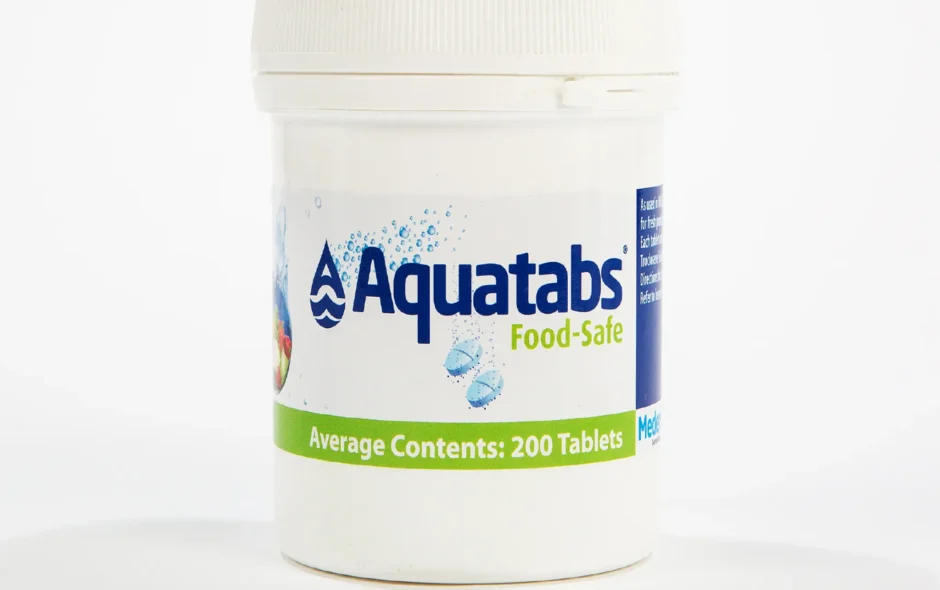
Aquatabs are the chlorine tablet aid agencies hand out after floods, and the 397 mg size is the one built for a household rather than a hiker. The EPA-accepted label says one tablet treats 4 gallons (15 liters) of clear water, or 1.5 gallons (5.8 liters) of water drawn from rivers, lakes, wells or cisterns at the higher dose; mix for at least 10 minutes and let it stand 30 minutes. The label lists the tablets as effective against bacteria, viruses and Giardia cysts, with the active ingredient NaDCC at 16.88 percent, certified to NSF/ANSI Standard 60.
The limit is printed on the same label: “not tested against cryptosporidium.” Aquatabs’ FAQ adds that strip packs keep for 2 to 5 years and that treated water in a closed container stays protected for at least 24 hours. Our full Aquatabs review covers the dose math for cans and bladders. Listing: Aquatabs 397 mg, 100 pack, on Amazon.
Potable Aqua Iodine Tablets: The Classic Kit
Potable Aqua’s germicidal tablets are the classic iodine kit: tetraglycine hydroperiodide, 8 mg of iodine per tablet, two tablets to a quart, a 5-minute loose-cap wait to rinse the threads, then 30 minutes before drinking. The maker says they are effective against bacteria and Giardia lamblia, and the PA Plus neutralizing tablets, sold alongside, remove the iodine taste and color after the 30 minutes are up. The maker’s current page says the tablets need no expiration date and that shelf life depends on storage; its 2002 EPA label said unopened bottles should remain effective up to four years. The maker says an opened bottle should be replaced for the next season or sooner if the tablets turn yellow-green.
The reasons it is not the top pick are on the maker’s own page: Potable Aqua is not effective against Cryptosporidium cysts, it is for short-term or limited emergency use only, and the CDC’s iodine cautions for pregnancy, thyroid conditions and iodine sensitivity apply. We go through the details, the taste and the PA Plus routine in our Potable Aqua review. The iodine tablets had no featured Amazon offer when this was written, so there is no listing link here.
Potable Aqua Chlorine Dioxide: Four-Hour Label Treatment
Potable Aqua’s chlorine dioxide tablets are the same brand’s answer to the Cryptosporidium gap. The maker’s page says one tablet treats one quart (one liter), that you allow 4 hours for treatment in an area away from sunlight, and that the tablets are effective against bacteria, viruses and cysts including Giardia lamblia and Cryptosporidium. Shelf life is 4 years from the date of manufacture, and the maker says the tablets improve the taste and smell of the water rather than adding to it.
The practical pattern is to treat the next day’s water the night before. Neither Potable Aqua chlorine dioxide listing had a featured Amazon offer when this was written, so it is included for comparison without a listing link; check the maker’s site for retailers.
Katadyn Micropur MP1: The Same Chemistry, Individually Wrapped
Katadyn’s Micropur MP1 is the other chlorine dioxide tablet, and its label is the clearest in this group. Each tablet treats 1 liter of water; sodium chlorite and NaDCC react in the water to generate a 4 ppm chlorine dioxide solution; the label says to allow it to react for 4 hours in an opaque container or in the dark, and that the tablets are effective against viruses, bacteria, Giardia and Cryptosporidium. It states the product meets EPA microbiological water purifier test standards, leaves no aftertaste and improves the taste and odor of treated water. Tablets are foil-wrapped one at a time in 20- and 30-count packs. Shelf life is not published on the label beyond the printed expiry date.
Neither Katadyn listing had a featured Amazon offer when this was written, so there is no listing link; Katadyn’s site lists retailers.
Which One for Which Reader
- Treating stored tap water, a bathtub bladder or cans: Aquatabs 397 mg. One tablet per 4 gallons is the only dose here that fits a household container such as a 60-gallon AquaTank2 bathtub bladder.
- A bug-out bag that may draw from a pond or a ditch: a chlorine dioxide tablet (Katadyn MP1 or Potable Aqua Chlorine Dioxide) behind a filter, with the 4-hour wait planned in. The Grayl GeoPress is the bottle-format alternative: Grayl says one 8-second press treats 24 ounces of fresh water for viruses, bacteria and protozoa, with a cartridge good for about 350 presses.
- A kit for someone who is pregnant or has a thyroid condition: anything but iodine.
- The glove-box kit you will forget about: Katadyn MP1, because each tablet is sealed on its own.
- An old-school backup: Potable Aqua iodine with PA Plus, for bacteria and Giardia only.
Common Questions
Do water purification tablets kill Cryptosporidium?
Iodine and plain chlorine tablets do not reliably kill it; the CDC says those chemistries do not work well against parasites, and the Aquatabs and Potable Aqua iodine labels say so for their own products. Chlorine dioxide tablets claim it after a full 4 hours in the dark, and the CDC says they will kill it as long as the instructions are followed. The CDC still calls boiling the best way to kill germs in water.
How long do water purification tablets last?
By the makers’ figures: Aquatabs strip packs 2 to 5 years, Potable Aqua iodine with no expiration date (shelf life depends on storage; its 2002 label said up to 4 years unopened) and one season once opened, Potable Aqua chlorine dioxide 4 years from manufacture, and Katadyn MP1 to the expiry printed on the pack. All four makers say to keep tablets cool, dry and sealed; humidity is what kills them.
Can I use tablets instead of boiling during a boil-water notice?
Follow the notice’s own wording first. For a boil water advisory, the CDC says to use commercially bottled water or boiled water for drinking and cooking, at a full rolling boil for 1 minute (3 minutes above 6,500 feet), and to boil tap water even if you filter it. If you cannot boil, follow your health department’s advice on treating the water; the CDC’s emergency page lists bleach or tablets used as the label directs, and neither boiling nor tablets remove chemicals.
Bottom Line
For a Gulf Coast household the tablet to keep is Aquatabs 397 mg: one tablet per 4 gallons treats the cans and the bathtub bladder that hold your real supply, the 30-minute wait is practical, and the label is honest about what it does not do. Add a strip of chlorine dioxide tablets to the bug-out bag for the Cryptosporidium case, and use stored or bottled water when floodwater may carry chemicals or salt.
Updated 2026-11-01: updated the iodine tablet shelf life, the Grayl comparison, the boil-advisory answer and the CDC’s current wording on chlorine dioxide and Cryptosporidium.
Some links on this page are Amazon affiliate links. If you buy through them, Ultimate Prepper’s Guide may earn a small commission at no extra cost to you.