Disclosure: this post contains Amazon affiliate links. If you buy through them, we may earn a small commission at no extra cost to you.
When the cell towers go down after a hurricane, the family radio in your kitchen drawer becomes the only way to reach someone two streets over. That is the job a prepper walkie talkie has to do: keep a household, a neighborhood watch, or an evacuation convoy talking when the phones cannot.
Before the picks, one piece of regulation matters more than any spec: the difference between FRS and GMRS. It decides whether you need a license, how much power the radio can legally put out, and whether you can use a repeater to reach across town. This guide covers that first, then the radios, then which one fits which household. For the wider picture of alerts, satellite messengers and a family plan, start with our emergency communications pillar guide.
FRS vs GMRS: What the FCC Actually Says
The Family Radio Service (FRS) is licensed by rule. The FCC says anyone of any age may use it for personal or business communication with no individual license. FRS has 22 channels in the 462 and 467 MHz range, shared with GMRS, with power limited to 2 watts on channels 1 through 7 and 15 through 22 and half a watt on channels 8 through 14. The FCC’s own range note is blunt: on channels 8 through 14 expect under half a mile, and the higher-power channels reach farther only when terrain and conditions allow.
The General Mobile Radio Service (GMRS) needs an FCC license. The license runs ten years, the applicant must be 18 or older, and any member of the licensee’s family, regardless of age, may operate under it. There is no exam. GMRS adds more power, 30 channels, and the right to use repeaters, which is how a handheld reaches across a county instead of across a subdivision. The FCC states a GMRS user can expect one to twenty-five miles depending on station class, terrain and repeater use. Since 2017 the FCC no longer certifies combined FRS/GMRS radios: a radio that includes the main 467 MHz channels or exceeds FRS power is a GMRS device, and you need the license to transmit on it.
Practical translation for a prepper household: if you want zero paperwork, buy FRS radios and accept short range. If you want repeater access and real power, get the GMRS license once for the whole family, then buy GMRS radios. Every radio below is labeled with which service it belongs to.
The Five Radios Compared
| Radio | Service | Channels | Power | Maker’s range claim | NOAA | Water rating | Battery | Weight |
|---|---|---|---|---|---|---|---|---|
| Midland GXT1000VP4 (2-pack) | GMRS, license required | 50 (22 plus 28 extra), 142 privacy codes | Not published | Up to 36 miles* | Alerts plus weather scan | JIS4 (splashing) | Rechargeable packs, desktop charger | Not published |
| Midland T71VP3 X-Talker (2-pack) | FRS, no license | 36, 121 privacy codes | FCC FRS limits apply | Up to 38 miles* | Alerts plus weather scan | Not published | Rechargeable packs, micro-USB | Not published |
| Cobra ACXT1035R FLT | 22-channel FRS/GMRS design; GMRS channels need the license | 22, 121 privacy codes | Not published | Up to 37 miles* | Alerts, 10 weather channels | IP67, floats | Rechargeable AA, 2-port dock | 5.6 oz |
| BTECH GMRS-PRO | GMRS, license required, repeater capable | 180 (6 banks of 30) | 5 W | No mile figure published | Weather channels | IP67 | 2600 mAh removable | 11 oz |
| Rocky Talkie 5 Watt | GMRS, license required, 8 repeater channels | GMRS plus 8 repeater, privacy codes | 5 W (high/low) | 35+ miles line of sight; 0.5 to 5 miles in forest; up to 1.5 miles in a city | Channels plus alert monitoring | IP67 | 1800 mAh replaceable, USB-C | 9.1 oz |
The asterisk after every big mileage number is the manufacturer’s own: those figures assume open terrain with nothing in the way. Rocky Talkie is the only maker on this list that publishes the honest version, with a separate figure for forest, river valleys and city blocks. Plan around the small numbers, not the large ones.
Midland GXT1000VP4: The Household Standard
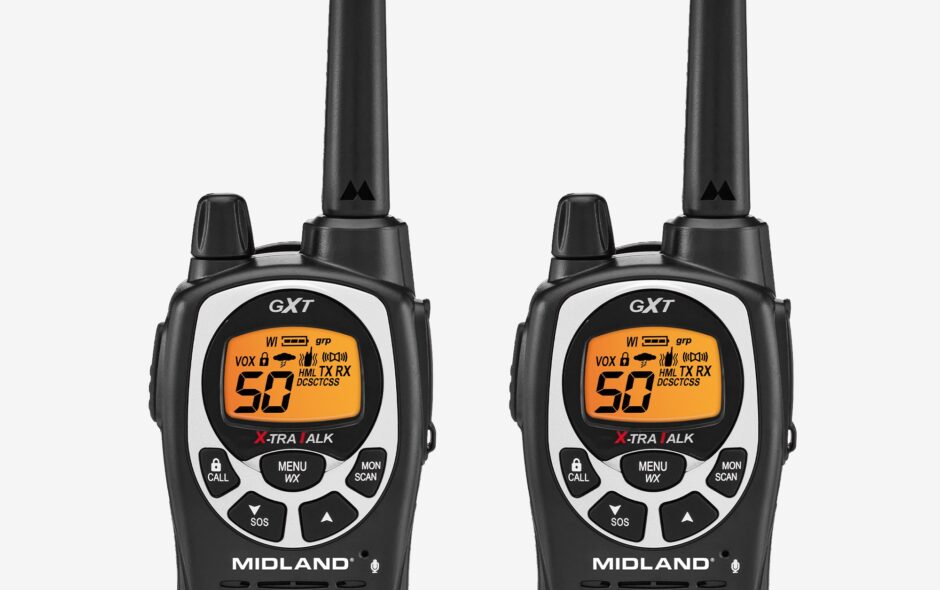
The Midland GXT1000VP4 is the radio most Gulf Coast households already recognize, and it earns its place: 50 channels, 142 privacy codes, NOAA weather alerts with scan, a JIS4 splash rating, an SOS siren, and boom-mic headsets in the box. Midland sells it as a GMRS radio, so budget for the family license. The weakness is the same one Midland shares across its handheld line: it publishes no transmit power and no weight on the product page, so you are trusting the brand rather than a spec sheet. For a two-radio home kit that charges on a desktop cradle and talks to the weather service, it remains the default pick. Our full review covers the range you can realistically expect. Listing: Midland GXT1000VP4 two-pack on Amazon.
Midland T71VP3: The No-License Option
If the idea of an FCC application is the thing stopping you from owning radios at all, the T71VP3 removes the excuse. It is an FRS radio, which means anyone in the house can key it with no paperwork, and it still carries NOAA weather alerts with scan, 36 channels and 121 privacy codes. The trade is power: FRS caps transmit at 2 watts on the main channels and half a watt on channels 8 through 14, so the 38-mile figure on the box is a best case you will never see between houses and trees. Charging is by desktop cradle or micro-USB, which matters during an outage because any power bank in the house can top it up. Midland does not publish a water rating or weight for it. Listing: Midland T71VP3 two-pack on Amazon.
Cobra ACXT1035R FLT: The One That Floats
Flooding is the Gulf Coast hazard, and the Cobra is the only radio here built for water first: IP67 sealing, a body that floats, and a speaker that clears itself of water with a burst of sound. It runs 22 channels with 121 privacy codes, carries NOAA alerts across 10 weather channels, charges rechargeable AA cells on a two-port dock, and weighs 5.6 ounces, the lightest on the list. Cobra does not state a service class; treat the GMRS channels as license territory and the low-power channels as FRS. Cobra also does not publish transmit power. For a boat, a dock, a kayak evacuation or a household that lives on a canal, this is the pick. Listing: Cobra ACXT1035R FLT on Amazon.
BTECH GMRS-PRO: The Repeater Radio
Once your family holds a GMRS license, repeaters are the feature that turns a handheld into a county-wide tool, and the BTECH GMRS-PRO is built around them: 5 watts, split-tone repeater support, 180 channel slots in six banks, IP67 sealing, a 2600 mAh removable battery, NOAA weather, plus Bluetooth app programming, GPS location sharing and texting between units. It is the heaviest radio here at 11 ounces and the most complex to set up; BTECH publishes no mile figure, which is more honest than a 36-mile asterisk but gives you nothing to plan against. If you know there is a GMRS repeater in your area and want to reach it, this is the radio for the job. Listing: BTECH GMRS-PRO on Amazon.
Rocky Talkie 5 Watt: The Honest Spec Sheet
The Rocky Talkie 5 Watt is the radio for people who want a GMRS handheld they can clip to a pack and forget: 5 watts with a low-power mode, eight repeater channels, IP67 submersion rating, NOAA channels with alert monitoring, a replaceable 1800 mAh battery charged by USB-C, and a stated four to six days of use per charge, at 9.1 ounces. What sets it apart is the range table Rocky Talkie publishes: 35 miles or more line of sight, two to eight miles in mountains, half a mile to five miles in forest, up to a mile and a half in a city. That is the kind of number you can plan an evacuation around. Our full Rocky Talkie review goes deeper. Listing: Rocky Talkie 5 Watt on Amazon.
Which One for Which Household
- Two adults, one house, no license yet: the Midland T71VP3. Add the GMRS license later and move up.
- A family that will get the GMRS license: the Midland GXT1000VP4 as the base pair, with headsets and a cradle that lives on the counter.
- Anyone near water or evacuating by boat: the Cobra ACXT1035R FLT, because a radio at the bottom of a canal helps no one.
- A neighborhood group with a repeater in range: the BTECH GMRS-PRO, and one person willing to program it for everyone.
- A go-bag radio that must survive abuse: the Rocky Talkie 5 Watt, clipped to the shoulder strap.
Whatever you choose, pair it with an alert receiver. A walkie talkie tells you about your family; a weather radio tells you about the storm. Our weather radio roundup covers that half, and the power outage checklist covers keeping all of it charged.
Common Questions
Do I need a license for a walkie talkie?
Not for FRS radios: the FCC licenses that service by rule, so anyone may use them. GMRS radios, which include the GXT1000VP4, GMRS-PRO and Rocky Talkie here, need one FCC license per family, valid for ten years, no exam, held by someone 18 or older. Family members of any age may then operate under it.
Why do the boxes say 36 miles when I get one?
The mileage claims assume line of sight across open terrain or water. Buildings, trees and hills soak up UHF signal, which is why Rocky Talkie’s forest and city figures are a tenth of its line-of-sight number. Expect a mile or two in a neighborhood, more from a rooftop or a boat.
Can these radios talk to each other across brands?
Yes, on the shared FRS and GMRS channels, as long as both radios are on the same channel and the same privacy code (or none). Privacy codes do not make a conversation private; they only filter what your radio plays.
Bottom Line
For most households the answer is a pair of Midland GMRS radios plus the family GMRS license; the GXT1000VP4 two-pack is out of stock on Amazon right now, so our closing link goes to the Midland T290VP4 two-pack from our Midland T290VP4 review (the GXT3000 two-pack from our Midland GXT3000 review ships later), with the Rocky Talkie 5 Watt as the upgrade for anyone who needs a radio that survives a bag and tells the truth about range. Buy the Cobra if water is your hazard and the T71VP3 if you want no paperwork at all.
Updated 2026-11-17: The GXT1000VP4 two-pack is out of stock on Amazon, so the closing link now goes to the Midland GXT3000 two-pack.
Updated 2026-11-18: the GXT3000 two-pack ships later on Amazon, so the closing link now goes to the in-stock Midland T290VP4 two-pack, which we now review.
Some links on this page are Amazon affiliate links. If you buy through them, Ultimate Prepper’s Guide may earn a small commission at no extra cost to you.