Disclosure: this post contains Amazon affiliate links. If you buy through them, we may earn a small commission at no extra cost to you.
Most evacuation planning starts with the bag and ends with the bag. That is backwards. When a Gulf Coast evacuation order goes out, the bag only matters if the car gets you from the driveway to somewhere the storm is not, and that trip has a way of exposing every weak point in a vehicle at once: a tired battery, a slow leak, a quarter tank of gas, and a phone that dies before you clear the county line. The car is the first piece of the kit. Everything else rides in it.
This guide walks through a hurricane evacuation car kit in three layers. First, the gear that keeps the car moving. Second, what rides in the cabin versus the trunk, so the things you need in traffic are within reach and the things you need at the other end are protected. Third, the route and communication tools that keep you from sitting still on a contraflow highway with no idea what is ahead. It builds on our 72-hour bug-out bag checklist, which covers what goes on your back. This one covers what goes under your seat.
Start With the Car, Not the Gear
Emergency management agencies along the Gulf Coast repeat the same advice every June: when a storm enters the watch stage, fill the tank and keep it full. Stations run dry in the 48 hours before landfall, and the ones that still have fuel often have no power to pump it afterward. A standing rule of never letting the tank fall below half during hurricane season costs nothing and removes the single most common reason people get stuck.
Beyond fuel, the car itself needs a pre-season check that most of us skip. Battery age (anything past four years in Florida heat is on borrowed time), tire tread and pressure including the spare, wiper blades, coolant, and a quick look at belts and hoses. Evacuation traffic means hours of idling in heat, which is exactly the condition that finds a weak cooling system or a marginal battery. A mechanic’s half-hour inspection in May is cheaper than a tow truck that cannot reach you in August.
Two items belong in every evacuation vehicle regardless of its age:
- A lithium jump starter. Evacuation traffic is stop-and-go with the air conditioning running, phones charging and the radio on, and a battery that was fine in the driveway can fail at a rest stop three hours later. A compact jump pack starts the car without a second vehicle and doubles as a USB power bank for phones. Our NOCO Boost GB40 review covers the model we recommend for gas engines up to about six liters.
- A 12V tire inflator and a plug kit. Debris on the road is the rule after a storm, not the exception. A slow leak you can top off every hour is a nuisance; a flat with no inflator is the end of your trip. Keep the inflator in the trunk with the plug kit and a pair of gloves, and know where the jack points are before you need them in the dark.
Round that out with a basic tool roll (adjustable wrench, pliers, screwdrivers, duct tape, zip ties), a tow strap, a flashlight or headlamp, and reflective triangles or a warning light. Jumper cables are still worth carrying as a backup to the jump pack, because they never run out of charge.
Cabin Versus Trunk
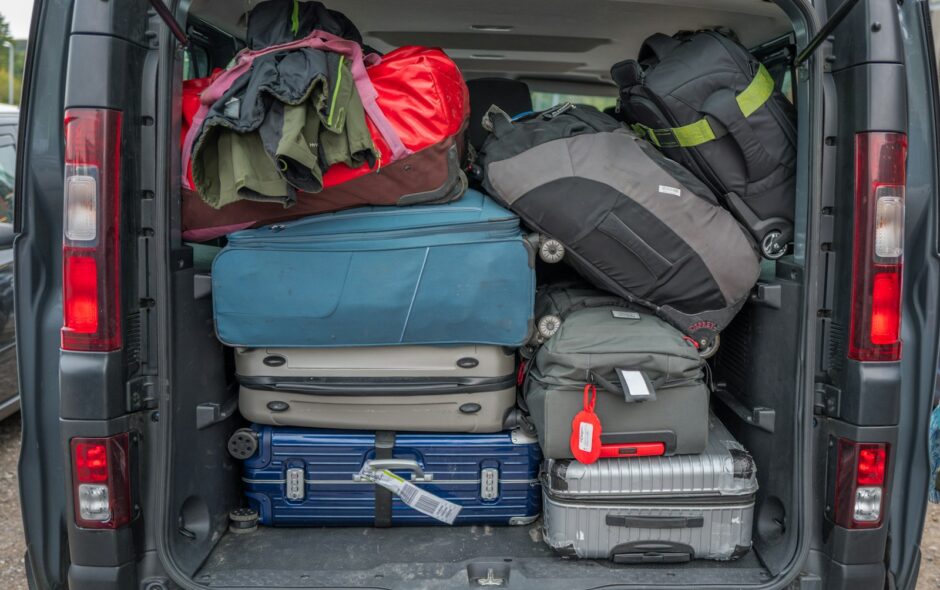
The mistake people make is packing the car like a moving van: everything goes in the back, and the first time someone needs the medication or the baby wipes, the whole load comes out on the shoulder of the interstate. Split the kit by when you will need it.
What rides in the cabin
Secure these items for passenger access; the driver should stop safely before retrieving supplies.
- Documents and cash. Driver’s licenses, insurance cards (home, auto, flood), a copy of the deed or lease, prescriptions, pet vaccination records, and enough cash in small bills to cover fuel and food for several days, because card readers go down with the power. Put all of it in a fireproof, water-resistant document bag that lives in the glove box or under the front seat. Photograph every document to your phone as well, and back the photos up to cloud storage before the storm.
- Medications. At least a week of every prescription, in original bottles, plus the over-the-counter basics. Temperature-sensitive medication needs a storage plan that meets its labeled limits; an insulated pouch alone may not maintain them.
- Water and snacks within reach. A bottle per person in the cabin and a bag of no-prep food (bars, nuts, dried fruit). Traffic that should take two hours routinely takes eight during a large evacuation. Our emergency ration bar review covers the dense, heat-stable option that lives in a car for years.
- A first aid kit. Not the drugstore box. Something with real wound care, a tourniquet and trauma dressings, because post-storm injuries are cuts from debris and glass. The SurviveX large first aid kit is sized for a vehicle; add a tourniquet if yours does not include one.
- Phone chargers and a power bank. One cable per device type, a multi-port 12V adapter, and a power bank charged the night before (our Anker 60,000mAh power bank review covers a large one with a built-in light).
- Comfort items that prevent bad decisions. Sunglasses, a hat, wet wipes, a roll of toilet paper in a zip bag, and something for the kids. People make poor calls when they are hot, hungry and miserable. A little comfort is a safety item.
What rides in the trunk
- The bug-out bags themselves. One per person, packed to the 72-hour checklist. Our bug-out bag roundup compares the Condor 3-Day, the LA Police Gear Atlas 72HR and the 5.11 RUSH72 2.0 if you are still choosing.
- Bulk water. A case of bottled water per two people, or filled jugs. It is heavy, so it goes low and forward in the trunk, not on top of the bags.
- Shelter and warmth. A tarp, a few mylar blankets, and a real blanket or sleeping bag per person. Shelters fill up, hotels sell out, and a night in the car at a rest area is a common outcome. Mylar is also what you reach for when someone is wet and shaking after a roadside stop in the rain.
- Vehicle recovery gear. The inflator, plug kit, tow strap, tool roll and gloves described above, plus a small folding shovel and a bag of cat litter or traction mats if you may end up on soft shoulders.
- Fuel, if you carry it. Only in an approved container, only secured upright, and never in the cabin. Plan fuel stops and reserve range from your vehicle’s actual consumption; do not assume a fixed container provides a fixed travel distance.
- Pet supplies. Food, water, a leash, a carrier, and the vaccination records that many shelters and hotels require.
Routes, Contraflow and Staying Informed
Every Gulf Coast state publishes evacuation zones and routes, and during a large evacuation the state may reverse inbound lanes (contraflow) on the main interstates so all lanes move away from the coast. Two things matter for your kit. First, contraflow has limited exits and no services for long stretches, so the fuel, water and snack planning above is not optional. Second, your phone’s navigation app will route you onto roads that are closed, flooded or reversed, because it does not know what the state troopers know.
- Paper maps. A current state road atlas and a county map for your home area. Mark your primary route, two alternates, and the rally point your family has agreed on. Phones die, cell towers go down, and map tiles do not load without data. A basic compass alongside the map is a cheap backstop if you end up on county roads at night.
- A NOAA weather radio. Watches, warnings and shelter information come over NOAA Weather Radio even when cell service is overloaded. A crank and solar unit such as the Midland ER310 runs with no batteries at all and adds a flashlight and a phone charger. Our weather radio roundup compares the options.
- A satellite check-in device. When cell networks fail, which they do across wide areas after a major landfall, a two-way satellite messenger still sends a text and your location to the family members who did not evacuate with you. The Garmin inReach Mini 2 is the compact option; the SPOT X is the alternative we have covered. Both need a subscription active before the storm, not during it.
- A signal whistle. Low tech, no battery, and loud enough to be heard over traffic and wind. The 7-in-1 whistle adds a compass and a light.
Decide the departure trigger before the season starts: a specific evacuation zone order, a specific storm category at a specific distance, or a specific time before expected landfall. Families that leave early sit in less traffic and find more open hotels. Families that wait for certainty spend the night on an interstate.
Evacuation Car Kit Checklist by Storage Location
| Location | Item | Notes |
|---|---|---|
| Cabin | Document bag with IDs, insurance, deed or lease, prescriptions, pet records, cash in small bills | Photograph everything to your phone too |
| Cabin | Medications, one week minimum, in an insulated pouch | Keep out of dashboard sun |
| Cabin | Water bottles, no-prep snacks, ration bars | One bottle per person within reach |
| Cabin | First aid kit with tourniquet and trauma dressings | Debris cuts are the common injury |
| Cabin | Phone chargers, 12V multi-port adapter, power bank | Charge everything the night before |
| Cabin | Paper maps with marked routes, compass, NOAA radio, satellite messenger, whistle | Subscription active before the storm |
| Trunk | One 72-hour bag per person | See the checklist guide |
| Trunk | Case of water per two people | Low and forward |
| Trunk | Tarp, mylar blankets, a blanket or bag per person | Plan for a night in the car |
| Trunk | Jump starter, inflator, plug kit, tow strap, tool roll, gloves, triangles, flashlight | Test the jump pack monthly |
| Trunk | Fuel in an approved container, secured upright | Never in the cabin |
| Trunk | Pet food, water, leash, carrier, records | Shelters often require records |
Maintaining the Kit
A car kit lives in the worst storage environment you own. Cabin temperatures in a Florida summer routinely pass 130 degrees, which shortens the life of batteries, medication, water bottles and food. Twice a year, at the start and end of hurricane season, pull everything out, replace the water and snacks, rotate the medication, charge the jump pack and power bank, and check the inflator still runs. Put a note on the calendar; nobody remembers on their own.
Keep the kit in the car you would actually evacuate in, which is usually the larger vehicle with the better range, and keep that vehicle’s tank above half from June through November. If the family splits between two cars, each car gets the cabin layer at minimum.
For the cold-weather version of the same kit, see our winter car emergency kit guide.
Common Questions
How much cash should we carry?
Enough for fuel, food and a night or two of lodging for the household, in small bills, because stores without power cannot make change and card networks fail with the towers. Agencies do not publish a figure; think in terms of several days of expenses rather than a round number, and split it between two people.
Is a jump starter really better than cables?
Cables need a second car and a driver willing to stop, which is not guaranteed on an evacuation route. A lithium jump pack works alone, fits in a glove box, and charges phones. Carry both; the cables are the backup that never needs charging.
What if we cannot evacuate in time?
Then the car kit becomes part of the shelter-in-place kit, and the decision is to stay off the road once conditions deteriorate. Driving into storm surge or over a flooded roadway is the leading cause of hurricane deaths on the Gulf Coast. Our power outage checklist and water storage guide cover the stay-home side.
Bottom Line
An evacuation car kit is not a second bug-out bag. It is a full tank, a healthy battery with a jump pack behind it, a way to fix a flat, documents and medication within arm’s reach, and a way to know where the road is open and to tell your family where you are when the phones stop working. Build it by location, cabin and trunk, refresh it twice a year, and decide your departure trigger now, while the Gulf is quiet. The families who do this spend evacuation day driving. The ones who do not spend it waiting.
After confirming it suits your vehicle, the NOCO Boost GB40 is the jump starter we keep on the evacuation kit list.
Some links on this page are Amazon affiliate links. If you buy through them, Ultimate Prepper’s Guide may earn a small commission at no extra cost to you.