Disclosure: this post contains Amazon affiliate links. If you buy through them, we may earn a small commission at no extra cost to you.
Gulf Coast houses are built to shed heat, not hold it, so when a hard freeze arrives with a power outage, people improvise. The improvising is where the danger is. A generator run in the garage, a grill brought inside, a gas oven left open for warmth, a space heater pushed against the bed: each one turns a cold night into a carbon monoxide or fire emergency. The CDC describes carbon monoxide as an odorless, colorless gas that “kills without warning.” The U.S. Fire Administration says heating fires remained the second leading cause of home fires in 2021.
This guide is the safety half of staying warm without power. It sets out what never comes inside, how to run an electric space heater and a fireplace safely, where carbon monoxide alarms go, and exactly what to do if one sounds, using guidance from the CDC, the CPSC, Ready.gov, the U.S. Fire Administration and the alarm makers. For the warmth half (layers, one warm room, sleeping bags), see our guide to staying warm when the power goes out.
Before the Cold Night: A Short Safety Check
Do this when a freeze is in the forecast, while the lights are still on.
- CO alarms with battery power. Battery-operated or battery-backup alarms on every level and outside every sleeping area, with fresh batteries, tested.
- Smoke alarms working. The CDC’s winter checklist says that if you will use a fireplace or wood stove, install a smoke detector and a battery-operated CO detector near the area to be heated, and test them monthly.
- An extinguisher you can reach. The CDC says to keep a multipurpose, dry-chemical fire extinguisher nearby. Our fire extinguisher roundup compares home units.
- Chimney and furnace checked. The CDC says to have a chimney or flue inspected each year if you plan to use a fireplace or wood stove for emergency heating, and to have the furnace system and vent checked by a qualified technician each winter season.
- The right space heater. One with automatic shut-off, from a recognized testing laboratory, with an undamaged cord.
- Light without flame. Flashlights and battery lanterns, not candles, for the dark hours.
- A place to go. Ready.gov says to go to a community location with power if heat or cold is extreme, and to check with local officials about heating locations open near you.
What Never Comes Inside
Using fuel-burning equipment in the wrong place can create a carbon monoxide emergency. The rule on this site is short: stoves, grills, generators, heaters and fuel repellers are never used indoors or in a garage, even with the door open, and are never set up on a porch, under a carport, in a tent or in any partly enclosed space. The agencies’ rules for portable equipment point the same way.
- Generators. The CDC says never to use a generator inside your home or garage, “even if doors and windows are open,” and to operate it outdoors more than 20 feet from windows, doors and vents. Our generator safety guide covers placement, cords and refueling.
- Gas ovens and stovetops. The CDC says “Never heat your house with a gas oven,” and Ready.gov says not to use a gas stove or oven to heat your home because it increases the risk of CO poisoning. Ready.gov’s winter page adds that using an oven or stovetop for heat can also increase the risk of fires and burns.
- Grills, charcoal and camp stoves. The CDC says never to burn charcoal indoors and never to use a portable gas camp stove indoors.
- Portable fuel-burning heaters. Kidde’s CO alarm guide names portable fuel-burning space heaters among the appliances that can produce CO. We do not recommend any portable kerosene, propane or other fuel-burning heater indoors, and the CDC says not to use portable flameless chemical heaters indoors either.
- Vehicles. The CDC says never to run a car or truck inside a garage attached to a house, “even with the garage door open.” For a vehicle running outdoors, the CDC says to make sure snow is not blocking the exhaust pipe, which reduces the risk of CO poisoning.
Electric Space Heaters: Distance, Outlet, Off
An electric space heater produces no carbon monoxide, but it is a fire risk, and the U.S. Fire Administration’s numbers show how serious: home portable heater fires were only 3 percent of home heating fires annually for 2017 to 2019 but accounted for 41 percent of fatal heating fires in homes. The rules from the U.S. Fire Administration’s heating handout and the CDC:
- Keep anything that can burn, “such as bedding, clothing and curtains,” at least 3 feet away from the heater.
- Choose a heater with automatic shut-off, “so if it tips over, it shuts off,” and only one from a recognized testing laboratory.
- “Plug portable heaters directly into outlets and never into an extension cord or power strip.”
- “Turn heaters off when you go to bed or leave the room.”
- Never cover a space heater, never set it on furniture or near water, never leave children unattended near one, never run the cord under a rug, and do not use one with a damaged cord or one that sparks (CDC).
In an outage, an electric heater needs a power source. A battery power station can sit indoors because it has no exhaust; plug the heater straight into the station’s outlet, and check the heater’s wattage against the station’s rated output before you count on it. A generator stays outdoors by the rules above, and the no-extension-cord rule for heaters still applies, so a heater on generator power belongs on a house circuit fed through a transfer switch installed by a licensed electrician, which our generator safety guide explains.
Fireplaces and Wood Stoves
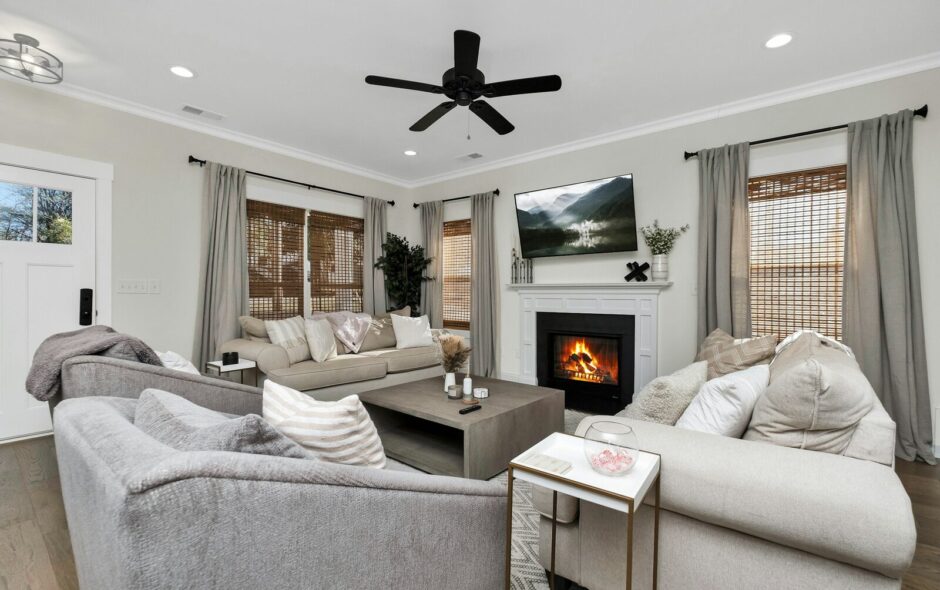
A fireplace or wood stove that is built into the house and vented to the outside is designed to be used indoors, but only when it is vented to the outside and maintained. The CDC says to use fireplaces, wood stoves or other combustion heaters only if they are properly vented to the outside, and not to burn paper in a fireplace. The U.S. Fire Administration’s fireplace and wood stove card adds:
- Keep anything that can burn at least 3 feet from the fireplace or wood stove.
- Keep a glass or metal screen in front of the fireplace to stop embers and sparks.
- Keep the wood stove’s doors closed unless loading or stoking the fire.
- Put the fire out before you go to sleep or leave your home.
- Have the chimney inspected and cleaned each year by a professional.
- Put ashes in a metal container with a lid, and place the container outside at least 10 feet from your home.
A lit fireplace is also a CO source when the chimney is blocked or the flue backdrafts; the CDC notes that debris can block chimneys and cause CO to build up inside. That is one more reason the CO alarm matters on fireplace nights. Kidde’s guide says not to install its CO alarms within 6 feet of heating or cooking appliances, or near chimneys, flues and vents, so put the alarm in the room or hall, not on the mantel.
Carbon Monoxide Alarms: Battery Power, Every Level
The CPSC says to install battery-operated CO alarms or CO alarms with battery backup on every level of the home and outside sleeping areas. Ready.gov says CO detectors with battery backup belong in central locations on every level, and the CDC says near every sleeping area. The word that matters is battery: a plug-in alarm with no backup is off for the whole outage.
Two maker details are worth knowing in a cold house. Kidde rates its current CO alarms to operate from 40°F to 100°F, and says not to install them where the temperature can fall below 40°F, such as porches and garages, so keep the alarm with the people, in the room you are heating. And Kidde’s plug-in alarms cannot run from a modified sine wave or square wave inverter, so a plug-in on a power station needs a pure sine wave output or should ride on its backup batteries. Our carbon monoxide alarm roundup compares four battery and battery-backup models, our Kidde COB review covers the AA battery model in detail, and our earlier Kidde KN-COB-LP2 review covers the model it replaced.
If the CO Alarm Sounds
Treat it as an emergency, every time.
- Get everyone out to fresh air at once, people and pets. The CPSC says that if you suspect CO poisoning, “get outside to fresh air immediately, and then call 911.”
- Call 911 from outside. Kidde’s user guide says to evacuate all occupants to fresh air outdoors and call emergency responders, 911 or the fire department.
- Do not go back in to find the source. Kidde’s FAQ says not to silence the alarm or try to locate the source yourself.
- If anyone feels sick, the same steps apply even if no alarm has sounded: fresh air, then 911.
- Do not restart whatever caused it. Kidde’s guide says never to restart the source of a CO problem until it has been fixed, and to have a qualified technician inspect fuel-burning appliances after responders have aired out the house.
One maker detail: pressing Test/Hush on a sounding Kidde alarm makes it recheck, and Kidde says that if it alarms again within 6 minutes it is sensing high CO, so exit to fresh air and call 911. Hush is not a reason to stay inside.
If a Fire Starts
Get out first. The U.S. Fire Administration says to use an extinguisher only when others have been alerted, 911 has been called, you can physically use it, the fire is small and contained, you are safe from smoke and you have a clear escape route; otherwise, alert others, leave the building and call 911. It also says young children and older adults should not use fire extinguishers. For a small fire that meets those tests, a 1-A:10-B:C home unit like the Kidde Basic 110 or the rechargeable First Alert HOME1 is the tool, mounted near an exit before you need it.
What This Guide Does Not Cover
This guide is about preventing carbon monoxide and fire while heating during an outage. It is not medical advice, and it does not list symptoms or treatment for CO exposure, hypothermia or frostbite. Cold exposure is dangerous in its own right; the CDC’s winter weather pages cover it, and anyone who may have breathed CO needs 911, not a checklist. This guide does not cover installing, repairing or converting furnaces, gas fireplaces or wood stoves (work for a qualified technician), and it does not cover portable kerosene or propane heaters, which some agency pages discuss with ventilation rules, because we do not recommend any portable fuel-burning heater indoors. Local codes and your landlord’s rules may add requirements.
Common Questions
Can I heat the house with the oven or stovetop for an hour?
No. The CDC says never to heat your house with a gas oven, and Ready.gov says not to use a gas stove or oven to heat your home and that using an oven or stovetop for heat can also increase the risk of fires and burns. The U.S. Fire Administration says never to use an oven to heat your home.
Is it safe to run an electric space heater all night?
The U.S. Fire Administration’s handout says to turn heaters off when you go to bed or leave the room. For the night, use sleeping bags, layers and one shared room instead; our staying warm guide covers how.
Can I use candles for heat or light?
Do not use candles for either. The CDC notes that candles can lead to house fires and says never to leave lit candles unattended. If one is lit anyway, NFPA’s rule applies: it goes out before anyone leaves the room or goes to sleep, it never burns overnight or in a bedroom, and it stays 12 inches from anything that can burn. Flashlights and battery lanterns give light with no flame, and our power outage checklist covers the rest of the outage kit.
Bottom Line
Heat safely in an outage by keeping combustion outside and alarms inside. No generator, grill, camp stove, gas oven or portable fuel heater indoors or in the garage; electric space heaters 3 feet from anything that can burn, plugged straight into the outlet and off when you sleep or leave; fireplaces screened, chimneys inspected and ashes in a lidded metal can outside. Put a battery-powered CO alarm on every level and outside every sleeping area, and if it sounds, get everyone outside and call 911. When the grid comes back, our restore checklist covers what to check. The Kidde COB runs on two AA batteries with no outlet, which is why our review recommends it for outage households.
Sources
- CDC: Carbon Monoxide (CO) Poisoning Basics
- CDC: Winter Weather: Before, During, and After
- CDC: Preparing for a Winter Storm
- CDC: Safety Guidelines During and After a Winter Storm
- CPSC: Carbon Monoxide Information Center
- Ready.gov: Power Outages
- Ready.gov: Winter Weather
- FEMA and U.S. Fire Administration: Heating Fire Safety handout (Ready.gov)
- U.S. Fire Administration: Heating Fire Safety
- U.S. Fire Administration: Fireplace and Wood Stove Safety card
- U.S. Fire Administration: Choosing and Using Fire Extinguishers
- Kidde: COB Carbon Monoxide Alarm, AA Battery Powered
- Kidde: Battery Powered Carbon Monoxide Alarms user guide
- Kidde: AC Plug-In Carbon Monoxide Alarms user guide
- NFPA: Candle safety
Some links on this page are Amazon affiliate links. If you buy through them, Ultimate Prepper’s Guide may earn a small commission at no extra cost to you.