
Disclosure: this post contains Amazon affiliate links. If you buy through them, we may earn a small commission at no extra cost to you.
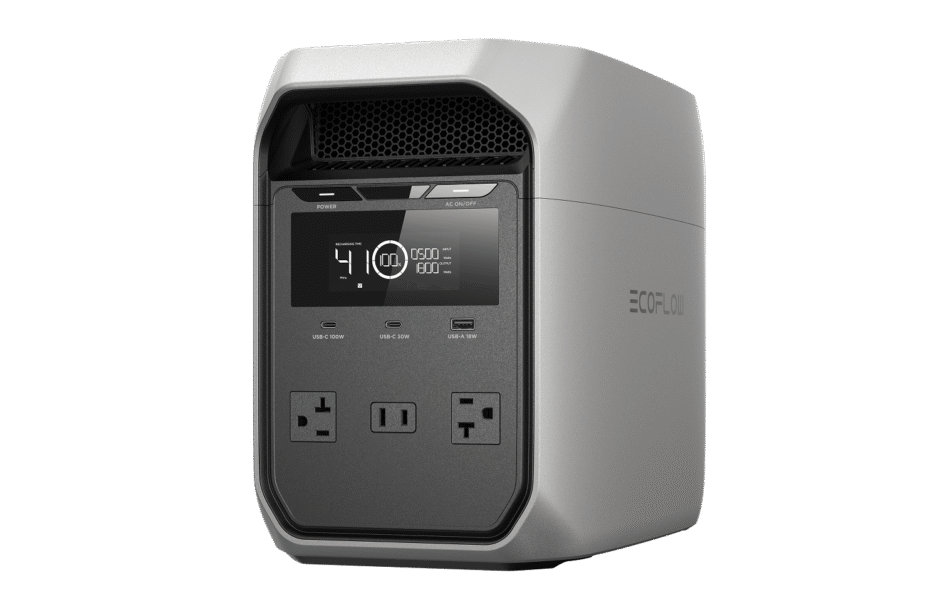
The one-kilowatt-hour power station is the purchase that changes a hurricane outage most for an ordinary household. It is the first size that runs a full-size refrigerator for a useful stretch, it still fits under an arm, and it charges fast enough to top off between the watch and the warning. For years our pick in that class was the EcoFlow DELTA 2. EcoFlow has since moved on: its DELTA 2 product page now forwards to the DELTA 3 line, and the DELTA 3 Classic is the model that takes the DELTA 2’s place at the entry to the range, with 1,024 watt-hours of lithium iron phosphate, 1,800 watts of rated output, and a 45 minute charge to 80 percent.
This review covers what EcoFlow publishes for the DELTA 3 Classic, who it suits, what it leaves out, and how it compares with the DELTA 2 it succeeds and the Jackery in the same class. For how a mid-size station fits with a fuel generator and the rest of the kit, start with our Power pillar, Backup Power for Hurricane Season, and the hurricane preparedness hub.
Who It Is For
The DELTA 3 Classic is for the household that wants the refrigerator, the phones, the router, a fan and a CPAP covered during an outage, for as long as its 1,024 watt-hours lasts at those loads, and wants the station to be ready on short notice. EcoFlow’s rated 1,800 watts with a 3,600 watt surge covers a refrigerator’s compressor start with margin; X-Boost, EcoFlow’s feature for running resistive loads above the rated output, is listed at 2,600 watts for things like a kettle or a hot plate. The 45 minute charge to 80 percent from a wall outlet is the storm-season feature: a station that has been sitting at half charge since spring is ready inside an hour once the watch is posted.
It is also the right size for a renter or an apartment household that cannot run a generator at all, because it is the largest station most people can carry up a flight of stairs without help. It is not for a well pump, a window air conditioner for more than a short spell, or a multi-day outage with no way to recharge; those jobs belong to the 3 kWh class or to a fuel generator.
Key Specs
| Spec | EcoFlow DELTA 3 Classic (EcoFlow figures) |
|---|---|
| Model | EF-DL3-C |
| Capacity | 1,024 Wh |
| Battery chemistry | LFP (lithium iron phosphate), automotive-grade full-tab cells |
| AC output | 1,800 W rated, 3,600 W surge; X-Boost for loads up to 2,600 W |
| AC outlets | 6 |
| USB | 1 x USB-C 100 W max, 1 x USB-C 30 W max, 1 x USB-A 18 W max |
| 12 V car output | None |
| AC input | 1,400 W; 0 to 80 percent in 45 minutes |
| Solar input | 500 W maximum; EcoFlow’s manual gives about 2.5 hours for a charge at 500 W, and its marketing gives about 1.8 hours to 80 percent in ideal conditions |
| Other charging | Car charging and generator charging listed; input figures not published |
| UPS | Switchover under 10 ms |
| Expansion battery | No |
| Cycle life | Not published; EcoFlow quotes a service life of about 10 years from internal simulation |
| Noise | As low as 30 dB under load (EcoFlow: under 30 dB at 600 W, measured at 0.5 m) |
| Weight | 12.1 kg (about 26.7 lb) |
| Dimensions | 398 x 200 x 283 mm (about 15.7 x 7.9 x 11.1 in) |
| App | EcoFlow app with Storm Guard mode |
| Operating temperature and warranty | Optimal 20 to 30 C (68 to 86 F); charge 0 to 45 C (32 to 113 F); discharge and storage minus 10 to 45 C (14 to 113 F); 5 year warranty (3 standard plus 2 with EcoFlow app registration) |
If a refrigerator-class station that is ready inside an hour is the gap in your kit, this is the one to price.
What We Like
The charging speed is the feature that sells it for hurricane country. EcoFlow rates the AC input at 1,400 watts and the charge to 80 percent at 45 minutes, which is faster than the 50 minutes EcoFlow lists for the DELTA 2 to reach 80 percent and close to the fastest in the class. In practice that means the station does not have to be babysat at full charge all season; it can live at a storage charge and come up to full in the time it takes to bring in the patio furniture. After the storm, the same input lets a generator run refill it; how long that takes depends on EcoFlow’s full-charge figure (EcoFlow’s US pages publish only the 80 percent time), the input rate you select and what the generator can supply.
The UPS switchover is listed at under 10 milliseconds, which EcoFlow calls fastest in its class. For a refrigerator that is irrelevant; for a router or a desktop computer it means the station can sit between the wall and the device all the time, and for a CPAP or any other medical device, confirm with the equipment maker that a sub-10 ms transfer is acceptable before relying on it. Pair that with a noise figure of about 30 decibels under a 600 watt load and the DELTA 3 Classic is a station you can run in the bedroom overnight with a fan and a CPAP on it and not hear.
Six AC outlets is generous for a one-kilowatt-hour unit, and it saves a power strip. EcoFlow lists 20 to 30 C (68 to 86 F) as the optimal operating range and rates charging, discharge and storage up to 45 C (113 F), so check a summer garage against those limits; it also quotes a 10 year service life, 95 percent humidity tolerance and salt-spray resistance. At 12.1 kilograms, about 26.7 pounds, it carries with one hand.
Limitations
The Classic is the trimmed version of the DELTA 3, and the trims show. There is no 12 volt car-style output port, so 12 volt gear such as a cooler or a GMRS mobile radio needs an inverter-fed adapter or a different station. There is no expansion battery, so 1,024 watt-hours is the ceiling; a household that wants to grow should look at a station with an expansion path. Solar input tops out at 500 watts, which is fine for a pair of 200 watt panels and not enough to use a bigger array.
EcoFlow publishes no cycle-life number for the Classic, only the 10 year service-life estimate. Its US specs page lists a 5 year warranty, 3 years standard plus 2 more after registering the unit in the EcoFlow app, so register it at purchase. The car and generator charging inputs are listed as features without published input figures. And like every station in this class, it will not run a central air conditioner or a 240 volt well pump, and a window unit will empty it in a few hours; the generator sizing guide explains when those loads push you to fuel.
Alternatives
The EcoFlow DELTA 2 is the station this one replaces: the same 1,024 watt-hours and 1,800 watts, a slower charge, and an expansion battery the Classic lacks. If you find one in stock, it remains a sound choice and our review still stands; EcoFlow’s own page for it now forwards to the DELTA 3 line, which is the clearest sign of where the company’s support is heading. The Jackery Explorer 1000 v2 is the other obvious comparison in the class, lighter still and with a simpler interface; the DELTA 3 Classic answers with more rated output, the 10 ms UPS and the faster charge.
If the load list is longer than a refrigerator and the small stuff, step up to the Bluetti Elite 200 V2 or the Jackery HomePower 3000. Our solar generator roundup compares the sizes side by side.
Common Questions
How long will it run a refrigerator?
EcoFlow publishes no refrigerator runtime for the Classic; it lists a 120 watt refrigerator among the loads the station handles and leaves the arithmetic to you. A refrigerator’s compressor cycles, so its average draw over a day is well below its label, and 1,024 watt-hours gives roughly six hours at a 150 watt average draw by the estimate in our backup power pillar, so measure your own refrigerator before counting on a full night and plan to recharge in daylight from panels or a generator. Our power outage checklist explains how to measure your own refrigerator’s draw before the season.
Is the DELTA 3 Classic the same as the DELTA 3?
No. The Classic is the entry model of the DELTA 3 line, with the same capacity and rated output but without the 12 volt output, the expansion battery and some of the ports of the full DELTA 3. For a household that wants one station for the refrigerator and the bedroom, the Classic covers the job; the full DELTA 3 is for someone who wants to grow the system.
Can it charge from a gas generator?
Yes. EcoFlow lists generator charging as a supported method, and the 1,400 watt AC input means even a mid-size inverter generator fills it quickly. Run the generator outdoors more than 20 feet from windows, doors and vents, never in a garage, and with a battery CO alarm in the house, per the CDC. Then shut the generator down and let the station carry the night in silence.
Bottom Line
The EcoFlow DELTA 3 Classic keeps everything that made the DELTA 2 our mid-size pick, the refrigerator-ready output and the one-hand weight, and improves the two things that matter most in a storm, the charge time and the UPS switchover, at the cost of the 12 volt port and the expansion path; for most Gulf Coast households that is the right trade, and this is the station to buy in the one-kilowatt-hour class.
Updated 2026-11-01: corrected the DELTA 2 charge-time comparison and added EcoFlow’s published temperature range and warranty.
Some links on this page are Amazon affiliate links. If you buy through them, Ultimate Prepper’s Guide may earn a small commission at no extra cost to you.