Disclosure: this post contains Amazon affiliate links. If you buy through them, we may earn a small commission at no extra cost to you.
Yes, solar panels work in winter. A panel turns light into electricity whatever the air temperature, and the Department of Energy notes that modules actually operate more efficiently in colder weather. What winter takes away is energy over the day: fewer hours of sun, a sun lower in the sky, more cloud on some days, and now and then ice or snow on the glass. On the Gulf Coast, where a hard freeze can take the power out for days, that difference decides whether a panel refills a battery by evening or only tops it up.
This guide explains each winter factor with figures from the Department of Energy’s winter guidance for solar systems, Renogy’s datasheet and installation manual for its 200W N-Type panel, and the national lab’s PVWatts calculator. It covers why output drops, why cold helps the cells but raises the voltage your controller has to handle, what to do about snow and ice, and a worksheet for estimating your own December output without guessing.
The Short Answer: Less Energy, Not No Energy
A panel’s watt rating is a test result, not a daily promise. Renogy rates its 200W N-Type at 200 W under standard test conditions: 1000 W/m2 of light on the panel with the cells at 25 degrees C. Its manual adds that maximum output comes when the panel faces the sun directly. On a winter day the panel spends fewer hours in usable light, and the light that reaches it arrives at a lower angle for most of those hours. Expect a daily total in watt-hours that falls short of summer’s, by an amount that depends on where you live and how the panel is set up.
That is the whole answer for planning: a panel is worth having in a winter outage, but size the plan to winter output, not to the number on the label.
Why Winter Days Produce Less
Shorter days. Fewer hours between sunrise and sunset means fewer hours of charging, and the low light near sunrise and sunset adds little. Plan the day’s charging for the middle hours.
A lower sun. Renogy’s manual explains that the sun’s elevation changes with the seasons and that a panel produces most when it faces the sun directly. In winter the sun is low, so it recommends a steeper tilt: about your latitude for year-round use, about latitude plus 10 to 15 degrees for winter. It says adjusting tilt for each season can raise winter output by 20 to 50 percent, and that the gain is largest at higher latitudes.
Longer shadows. A low sun throws long shadows, so a tree, roofline or fence that never touched the panel in June can shade it in December. Renogy lists shade, dirt and cloudy weather among the causes of underproduction; check the site at midday in winter, not summer, before you mount anything.
Cloud and rain. Winter fronts can bring days of overcast. A panel still produces something under cloud, but Renogy’s FAQ names cloudy weather as a cause of reduced output, and no maker figure tells you how much. Plan for a run of gray days with stored energy, not with panel watts.
Cold Helps the Panel
The cold that makes a house hard to heat is good for a solar cell. The Department of Energy’s winter guidance says PV modules operate more efficiently in colder weather, because temperatures above 77 degrees F cause decreases in voltage. A datasheet puts a number on it as the temperature coefficient of maximum power. Renogy lists -0.32 percent per degree C for its 200W N-Type: for every degree the cells run below 25 degrees C, they make about 0.32 percent more power from the same light, and for every degree above, about 0.32 percent less.
Two cautions keep that from being oversold. Cold does not add sunlight; it only means the cells waste less of the light they get, so a short, low-sun day still collects less than a long summer one. And the coefficient applies to the temperature of the cells, not the air, so read it as a direction, not a forecast.
Cold Also Raises Voltage: Check Your Controller or Station
Here is the part of winter solar that can damage equipment. A panel’s open-circuit voltage, the voltage with nothing drawing current, also rises as the cells cool. Renogy lists a Voc coefficient of -0.26 percent per degree C and an open-circuit voltage of 37.44 V at 25 degrees C for the 200W N-Type. Its installation manual says to correct Voc for the lowest local temperature, add a 10 to 20 percent safety margin, and make sure the result never exceeds the PV maximum input voltage of the controller, inverter-charger or power station; exceeding it will damage the device.
Worked example, our arithmetic from Renogy’s figures (Renogy’s printed formula carries a sign that would lower the voltage if taken literally; its own troubleshooting table says a higher Voc in the cold is normal, so the table raises it by 0.26 percent per degree below 25 degrees C):
| Cell temperature | One panel Voc | One panel, plus 20 percent | Two in series | Two in series, plus 20 percent |
|---|---|---|---|---|
| 25 °C (77 °F) | 37.44 V | 44.93 V | 74.88 V | 89.86 V |
| 0 °C (32 °F) | 39.87 V | 47.85 V | 79.75 V | 95.70 V |
| -10 °C (14 °F) | 40.85 V | 49.02 V | 81.69 V | 98.03 V |
Then read the device’s manual. Anker’s user guide for the SOLIX C200 DC, a small station, says its solar input supports an 11-28 V solar charger with an XT-60 connector, so the Renogy panel is out for that station at any temperature. A charge controller whose PV input tops out near 50 V handles one panel with margin but not two in series; for two in series, the -10 degrees C figure calls for roughly 100 V of input headroom. Our Renogy 200W N-Type review covers the panel’s other limits, and power stations in cold weather covers the station side.
Snow, Ice and Frost on the Glass
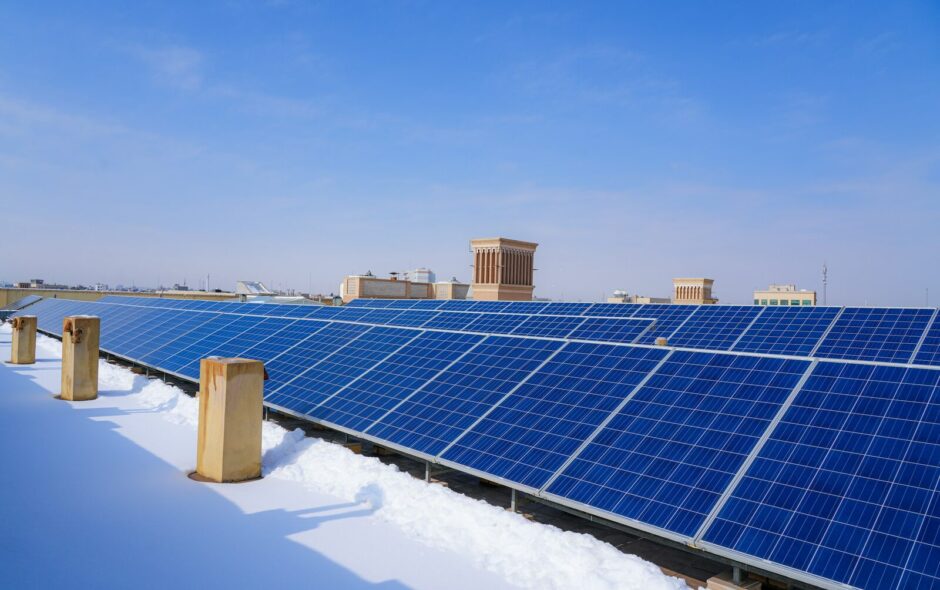
Anything on the glass blocks light. The Department of Energy’s winter guidance for solar systems says:
- Most snow will melt quickly off PV systems or be blown off by wind.
- In severe snowstorms, the weight of accumulated snow may cause a module to warp or even break, and ice can both add to and redistribute that weight.
- Steeper tilts shed snow faster, with significant gains around 30 to 35 degrees, and landscape orientation helps because snow typically melts first from the tops of the modules.
- A typical module load rating is 2,400 Pa; where heavy snow accumulates, choose modules certified to at least 5,000 Pa, and find the rating in the module’s installation manual.
- Removing accumulated snow or ice is not recommended; if it must be done, use a broom or brush, never a shovel, and never step or stand on the panels.
Renogy’s manual agrees on the essentials: its troubleshooting table lists snow among the obstructions that cut output, and it says never to walk on a panel and not to work in rain, snow or high winds. For a roof-mounted panel that means waiting for the glaze to melt rather than climbing an icy roof; a ground mount at a steep winter tilt is the easier panel to keep clear. Water is the other winter risk: the Department of Energy notes that water entering an electrical enclosure can freeze and expand, and Renogy says unmated connectors are not waterproof, so keep connectors mated or capped.
Estimate Your Own Winter Output
No maker can tell you what a panel will make in your yard in December, and we will not guess for you. The tool for this is PVWatts, provided by the National Lab of the Rockies (a Department of Energy lab), which estimates the energy production of grid-connected PV systems anywhere in the world and lets you download monthly results. Here is the method for one 200 W panel:
- Enter your address on the PVWatts site.
- Set the system size to 0.2 kW for one 200 W panel, then enter the tilt and the direction the panel faces as the site asks for them.
- Choose the array type that matches your mount, and leave the default losses unless you know better figures.
- Run it and open the monthly results. Note the December and January AC energy figures, and June’s for comparison.
- Divide each winter month’s figure by its number of days for a daily average, and multiply by 1,000 to turn kWh into Wh.
- Compare that daily figure with your written list of winter loads in watt-hours.
| Line | What to enter | Where it comes from |
|---|---|---|
| A | December AC energy for a 0.2 kW system, in kWh | PVWatts monthly results |
| B | Daily average: line A divided by 31, times 1,000, in Wh | Your arithmetic |
| C | Daily winter load, in Wh | Your load list: each device’s watts times hours of use |
| D | Line B minus line C | If negative, the panel cannot keep up and stored energy covers the gap |
| E | Days your battery covers with no sun | Battery or station capacity in Wh divided by line C |
Treat the solar result as a seasonal comparison and the nameplate-capacity runtime as an ideal upper bound before conversion losses, the station’s own consumption and a reserve. The PVWatts page warns that its predictions include many inherent assumptions and uncertainties, that it does not tell better-performing modules from lesser ones, and that its output range comes from 30 years of historical weather, so a given week can run well below the average. PVWatts models a grid-connected system, so its AC output is not a calculation of the energy delivered through your charge controller, battery and power-station outputs.
The Panel Is Rated for Cold; Check the Battery Too
Renogy rates the 200W N-Type to operate from -40 to 85 degrees C, but that rating covers the panel alone. The battery bank, charge controller or power station on the other end of the cable has its own temperature limits, which its own manual gives, and Renogy’s manual says those devices’ instructions govern. Before a freeze, look up the charging temperature range of whatever the panel feeds, and plan where it will sit. Our guide to power stations in cold weather walks through charging, storage and runtime limits for stations.
Which Setup Fits Your Household
Winter output is the same physics for every panel; what differs is how much work the setup takes and what it can run.
- Renters and apartments: a folding portable panel set out in the sun during the day and stored at night, feeding a power station. Our Renogy 200W portable review covers one.
- Homeowners with a sunny roof or yard: a rigid panel on a permanent, professionally installed mount, feeding a controller and battery bank. Our Renogy 200W N-Type review covers one, voltage limits included.
- One box, no wiring: a solar generator, meaning a power station sold with or sized for panels. Our solar generator roundup compares them.
- Bigger loads than a panel can refill in winter: our backup power pillar compares generators with power stations. A generator is never used indoors or in a garage, even with the door open, and never on a porch, under a carport, in a tent or in any partly enclosed space; the CDC says to operate it outdoors more than 20 feet from windows, doors and vents, and to install battery-operated or battery back-up CO detectors near every sleeping area.
What This Guide Does Not Cover
This guide is about small battery-based systems in an outage. It does not cover grid-tied rooftop systems: Renogy’s manual says to consult your local utility first for grid-tie systems, and your installer can tell you what yours does when the grid is down. It is not an engineering calculation: roof loads, wiring, fusing and code compliance belong to a licensed professional, as Renogy’s manual requires. And it gives no output figures for your address; PVWatts does that.
Common Questions
Do solar panels work on cloudy winter days?
They produce less. Renogy names cloudy weather among the causes of reduced output and publishes no figure for how much, and PVWatts builds its estimates from historical weather, so its monthly figure reflects a typical mix of clear and cloudy days. Size stored energy for a gray spell rather than counting on the panel.
Should I clear snow or ice off my panels?
Usually not. The Department of Energy says removal of accumulated snow or ice is not recommended, most snow melts or blows off, and if removal is needed it should be gentle, with a broom and not a shovel. Never climb onto an icy roof or step on a panel to do it; Renogy warns that stepping on a panel can crack cells and lead to fire.
Can freezing weather damage a solar panel?
For a Gulf Coast freeze, the cold itself is inside the rating; Renogy’s 200W N-Type is rated to -40 degrees C. The winter risks are elsewhere: snow and ice load on the frame and glass, water freezing inside enclosures, and a cold-morning open-circuit voltage that exceeds what the controller or station can accept.
Bottom Line
Solar panels work in winter, and cold weather helps the cells; what shrinks is the daily total, because the days are shorter, the sun is lower and clouds come through. Plan with your own PVWatts numbers, tilt steeper for winter, keep the glass clear without climbing on anything icy, and check that the cold-morning voltage stays inside the limits of whatever the panel feeds. For a fixed system, the Renogy 200W N-Type publishes every figure a winter voltage check needs, and our Renogy 200W N-Type review covers its limits.
Sources
- U.S. Department of Energy (FEMP): Solar Photovoltaic Hardening for Resilience, Winter Weather
- National Lab of the Rockies: PVWatts Calculator
- Renogy: 200W N-Type High Efficiency Solar Panel (RSP200DC-G1 datasheet and Solar Installation & Maintenance manual)
- Anker: SOLIX C200 DC Portable Power Station User Guide
- CDC: Carbon Monoxide (CO) Poisoning Basics
Some links on this page are Amazon affiliate links. If you buy through them, Ultimate Prepper’s Guide may earn a small commission at no extra cost to you.