
Disclosure: this post contains Amazon affiliate links. If you buy through them, we may earn a small commission at no extra cost to you.
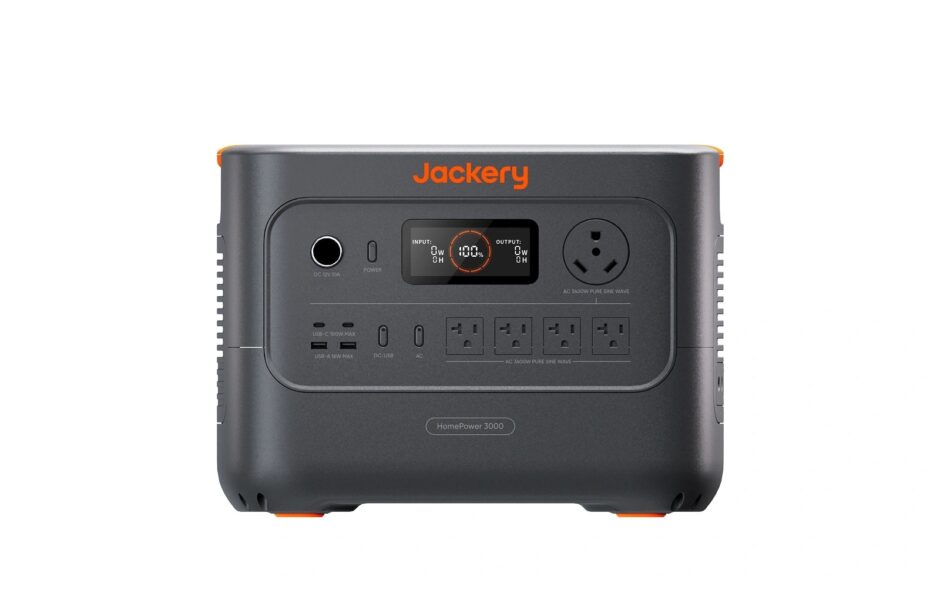
The long outage is the one that sorts backup power into two piles. A phone charger and a fan get a household through the first night; the refrigerator, the freezer, the medical gear and the second and third nights need something in the three kilowatt-hour class, and until recently that class meant a unit too heavy for one person to move. The Jackery HomePower 3000 is Jackery’s answer to that: a 3,072 watt-hour lithium iron phosphate station rated for 3,600 watts of continuous output and a 7,200 watt surge, in a box Jackery describes as the smallest and lightest 3 kWh LFP station on the market.
This review covers what Jackery publishes for it, who it suits, where it falls short, and how it compares with the Anker SOLIX F3000 we already review at the same capacity. For how a station this size fits with a fuel generator and the rest of the kit, start with our Power pillar, Backup Power for Hurricane Season, and the hurricane preparedness hub.
Who It Is For
The HomePower 3000 is for a household that wants to run real appliances through a multi-day outage without a generator running all day: a full-size refrigerator, a chest freezer, a window air conditioner for part of the day, a CPAP every night, and the phones, routers and lights on top. Jackery’s own runtime figures put a refrigerator at one to two days, a DC light at nine to ten days, a fan at 60 hours and a Wi-Fi router at 66 hours on one charge. It also suits the household that already owns a gas generator and wants to use it for an hour or two a day to refill a battery instead of running it from dawn to midnight, which is the routine our generator safety guide recommends. The TT-30 RV outlet makes it a natural fit for anyone who evacuates in a travel trailer.
It is not for the apartment prepper who needs a fan and a phone, and it is not a whole-home system. At about 59.5 pounds it is a one-person lift for a fit adult, but it is not something you carry up a flight of stairs in a hurry, and it has no wheels.
Key Specs
| Spec | Jackery HomePower 3000 (Jackery figures) |
|---|---|
| Model | JHP-3000C |
| Capacity | 3,072 Wh |
| Battery chemistry | LiFePO4 (lithium iron phosphate) |
| AC output | 3,600 W continuous, 7,200 W surge, pure sine wave |
| AC outlets | 4 x 120 V 20 A household outlets, plus 1 x TT-30 RV outlet (120 V, 30 A) |
| USB | 2 x USB-C, 100 W max each; 2 x USB-A, 18 W max each |
| DC | 12 V 10 A car-style port |
| AC recharge | 0 to 80 percent in about 1.6 hours; full in about 2.2 hours |
| Solar recharge | 0 to 80 percent in about 9 hours with two SolarSaga 200 W panels; maximum solar input not published |
| AC plus solar | Up to 2,500 W combined; 80 percent in 65 minutes, full in 1.7 hours |
| UPS | UL-certified UPS, switchover within 20 ms |
| Cycle life | 4,000 cycles to 70 percent capacity; Jackery quotes a 10-year lifespan |
| Standby loss | ZeroDrain: 95 percent charge retained after 365 days switched off |
| Expansion battery | Not published |
| Weight | About 59.5 lb (27 kg) |
| Dimensions | 16.4 x 12.8 x 12 in |
| Transfer switch | Jackery says it connects to a manual transfer switch to power up to 6 essential circuits |
| Connectivity | Wi-Fi and Bluetooth, Jackery app |
| Noise and operating temperature | Noise not published; charge 0 to 45 C (32 to 113 F), discharge minus 15 to 45 C (5 to 113 F), storage for up to a year 0 to 25 C (32 to 77 F), per Jackery’s manual |
If the capacity and the 30 amp outlet are what your load list needs, this is the station to compare against the F3000 below.
What We Like
The output is the headline. Four household outlets rated at 20 amps each and a TT-30 outlet let the HomePower 3000 run a refrigerator, a freezer and a window unit at the same time, and the 7,200 watt surge covers the compressor start that trips smaller stations. Jackery rates each household outlet at 20 amps (2,400 watts) and the station at 3,600 watts combined, so no single household outlet carries the full output; the TT-30, rated at 30 amps and 3,600 watts, is there for a travel trailer or a transfer cord.
The recharge speed matters more in hurricane season than in any other use. A full charge from the wall in about 2.2 hours means a station you forgot about can be ready between the watch and the warning. After the storm, Jackery’s dual-charging figure of 80 percent in 65 minutes from AC plus solar means a short generator run plus panels in the yard refills it before lunch, and the 20 ms UPS keeps a refrigerator or a CPAP running through the moment the grid drops if the station is already in line.
Then there is the weight. Jackery’s claim that this is the smallest and lightest 3 kWh LFP station is backed by a figure of about 59.5 pounds in a 16.4 by 12.8 by 12 inch box; the Anker SOLIX F3000, at the same capacity, is 91.5 pounds on wheels. For a station that may have to move from the garage to the hallway while the wind is already blowing, that difference is not academic. ZeroDrain is a quiet bonus: 95 percent of the charge still there after a year on the shelf is exactly the behavior you want from storm gear that sits idle for ten months.
Limitations
Jackery does not publish an expansion battery for the HomePower 3000 in the material we could read, and that is the real gap against the Anker F3000, which stacks three expansion packs. Three kilowatt-hours is a capacity rating, not a household runtime; work out your daily energy use and a realistic recharge before planning a multi-day outage, and if you want to grow into a week of refrigerator and air conditioner, the Anker’s path is clearer. Jackery also does not publish a maximum solar input figure; it publishes a nine-hour time to 80 percent with two 200 watt panels and a 2,500 watt combined AC plus solar ceiling, which is informative but not the same thing.
The unit is 120 volt only. Like every portable station in this class, it will not run a central air conditioner or a 240 volt well pump, and no accessory changes that. It has no wheels and no telescoping handle; at 59.5 pounds, plan on a hand truck for a long carry. Jackery publishes no noise figure. Its manual limits charging to 0 to 45 C (32 to 113 F), discharge to minus 15 to 45 C (5 to 113 F) and storage for up to a year to 0 to 25 C (32 to 77 F), so a summer garage can run past the storage range; battery chemistry alone does not establish safe conditions. Finally, the 2.2 hour AC recharge wants a healthy household circuit; a station charging at full rate on a 15 amp circuit shared with other loads may trip the breaker, and the Jackery app’s Quiet Charging Mode reduces the charging power.
Alternatives
The direct comparison is the Anker SOLIX F3000: same 3,072 watt-hours, same 3,600 watts, same LFP chemistry and TT-30 outlet. The Anker adds a dedicated 3,600 watt generator charging input, up to 2,400 watts of solar input, expansion to 12,288 watt-hours with three packs, and wheels; it costs that in weight, at 91.5 pounds. Both makers rate each 20 amp household outlet at 2,400 watts within a 3,600 watt total. Choose the Jackery for the lighter, smaller box; choose the Anker for the generator input and the expansion path.
For a household whose load list is a refrigerator and the small stuff, a 2 kWh-class station such as the Bluetti Elite 200 V2 or a 1 kWh-class one such as the EcoFlow DELTA 3 Classic weighs about half as much. Our solar generator roundup lays the sizes side by side, and the generator sizing guide helps you decide whether the top of the list is where your money should go.
Common Questions
Can it run a refrigerator through a hurricane outage?
Yes. Jackery’s own figure is one to two days for a refrigerator on a single charge, and the 7,200 watt surge handles a compressor start with room to spare. Stretching that to a five-day outage means recharging in daylight, from panels or from a generator run (a full AC charge is about 2.2 hours by Jackery’s figure, less with solar alongside), which the dual charging input is built for.
Can I charge it from a gas generator?
Yes, through the ordinary AC charging cable plugged into the generator’s outlet, with the generator outdoors more than 20 feet from any window, door or vent. Jackery does not publish a separate generator input the way Anker does, so the charge runs at the normal AC rate: about 2.2 hours from empty if the generator can supply it. A small inverter generator may need Quiet Charging Mode turned on in the Jackery app, which reduces the charging power.
Can it run a central air conditioner?
No. Central air needs 240 volt service, which this 120 volt station does not supply; any other arrangement needs a model-specific compatibility check and a qualified electrician. What the HomePower 3000 can run is a window unit or a portable air conditioner for part of the day, and a battery fan for all of it. Plan sleep around that rather than around the thermostat.
Bottom Line
The Jackery HomePower 3000 puts three kilowatt-hours and 3,600 watts in what Jackery calls the smallest and lightest 3 kWh LFP station, recharges fast enough to be ready between the watch and the warning, and holds its charge through a year of waiting; what it gives up to the Anker F3000 is the generator input and the expansion path, and if neither is on your list this is the simpler, lighter choice for a multi-day Gulf Coast outage.
Updated 2026-11-01: corrected the outlet ratings to Jackery’s 2,400 watts per household outlet within the 3,600 watt total, and added the temperature limits from Jackery’s manual.
Some links on this page are Amazon affiliate links. If you buy through them, Ultimate Prepper’s Guide may earn a small commission at no extra cost to you.